


Compliant hiring,
instantly.
Don't let complex Australian employment laws slow down your recruitment. Use AI to run a first-pass review on employment contracts to ensure they align with local standards.
Build a contractAnd the ones already out there get checked too.
Everyone takes it
from the same place.
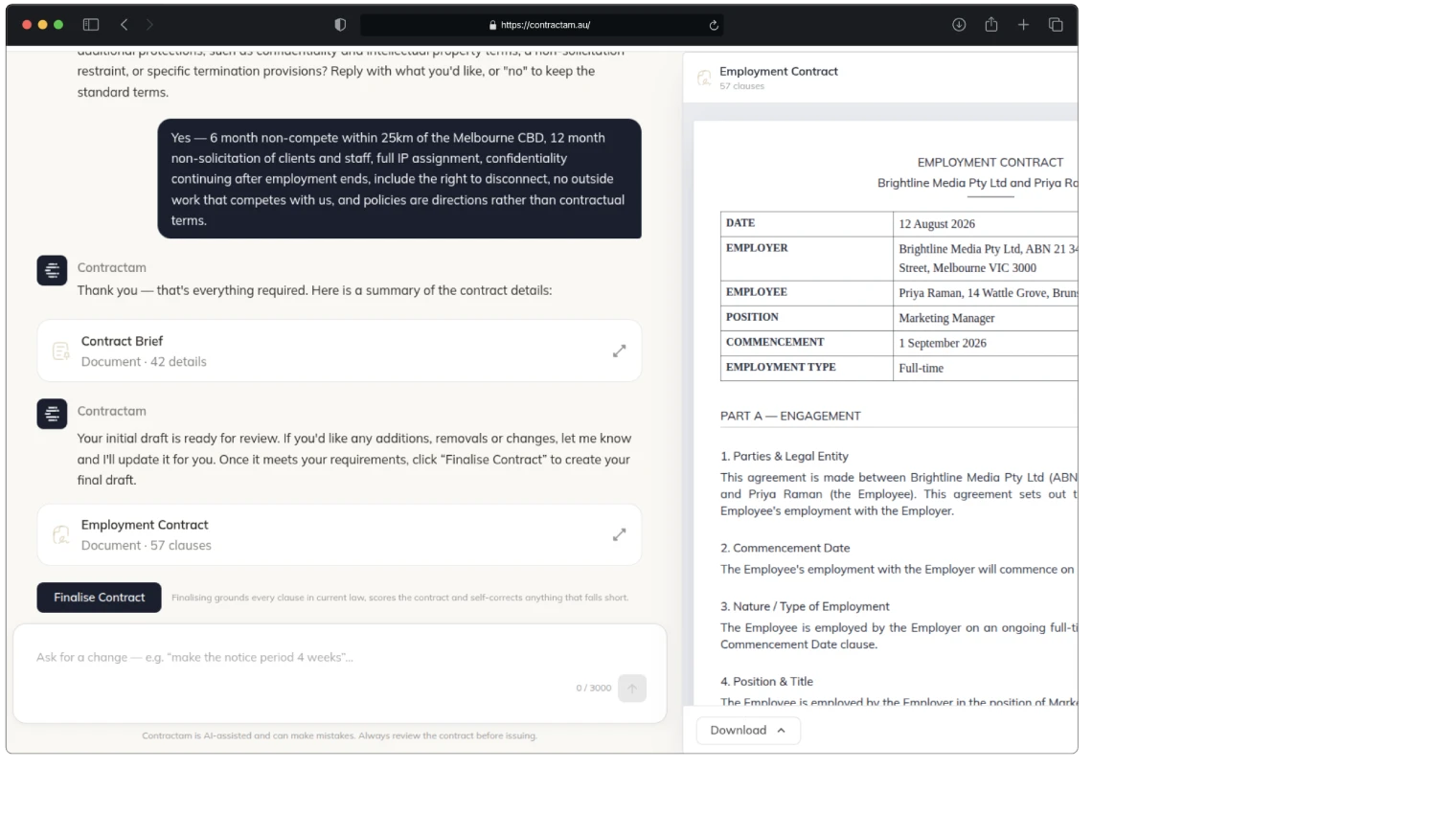
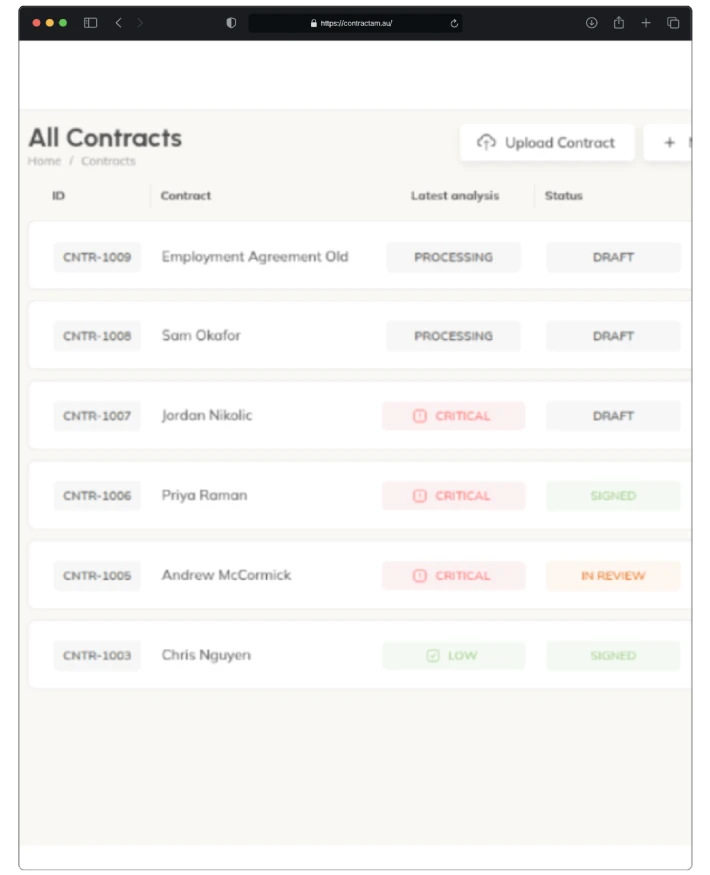
One current version of every contract, and it's the only one anyone can send. No copies in folders, no asking which one was used last time.
One source, not five folders
Only one current version — There's nothing else to send. The old ones can't be picked up by mistake.
Changes happen once — Update it and every contract issued after that carries the change.
Same role, same terms — Two people hired into the same job get the same notice, the same probation, the same restraint.
The right level.
The right rate.
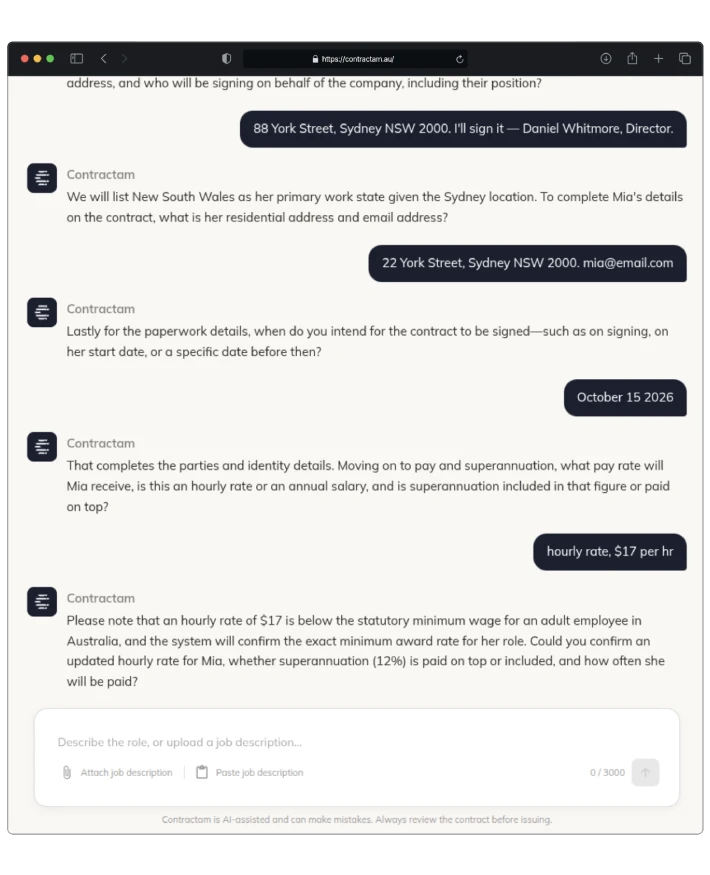
Classification decides the rate, and the rate decides everything that follows it. Both are checked against the Modern Award that covers the role.
Checked before it's offered
The level, not a guess — Matched to the duties in the role, not to the title on the job ad.
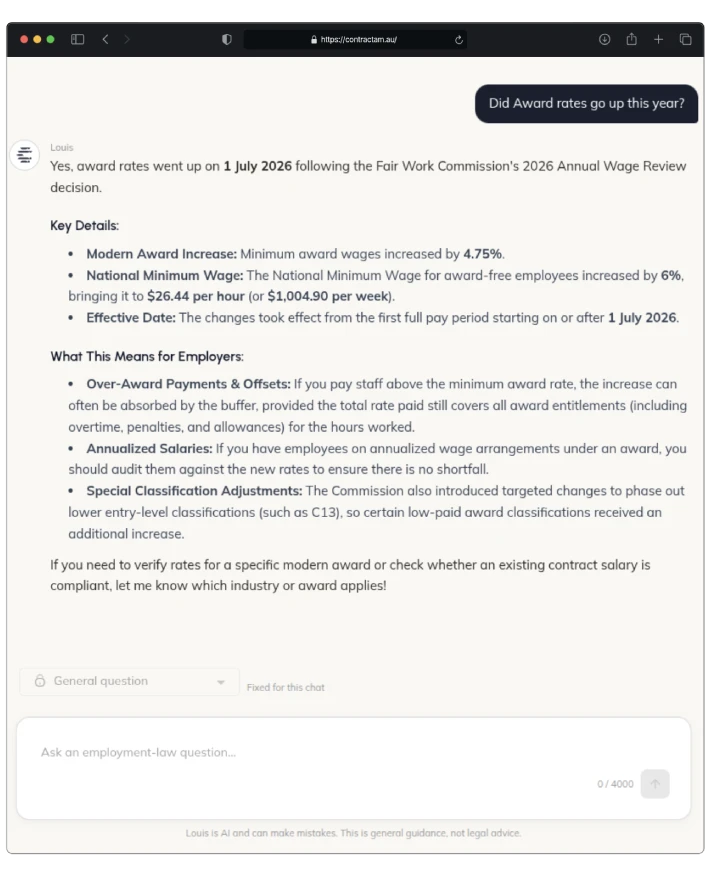
The rate that applies today — Award rates change on 1 July. The contract carries the one in force now.
Loadings and allowances too — Weekend penalties, casual loading, and the allowances that only exist in your industry.
The law changed.
Your contracts didn't.
Rates move on 1 July. Superannuation rules changed in 2026. Contracts issued before that are still carrying the old terms, and nobody gets a reminder.
What gets caught
The contracts already signed — Not just the next one. The ones issued last year are checked against the law as it stands now.
Superannuation, at the current timing — Payday Super started on 1 July 2026. Contributions have to reach the fund within 7 business days of payday.
Which ones actually need changing — The contracts affected, and the clause in each one that has to move. Not a list of everything you hold.
Ask what the law says
before you do it.
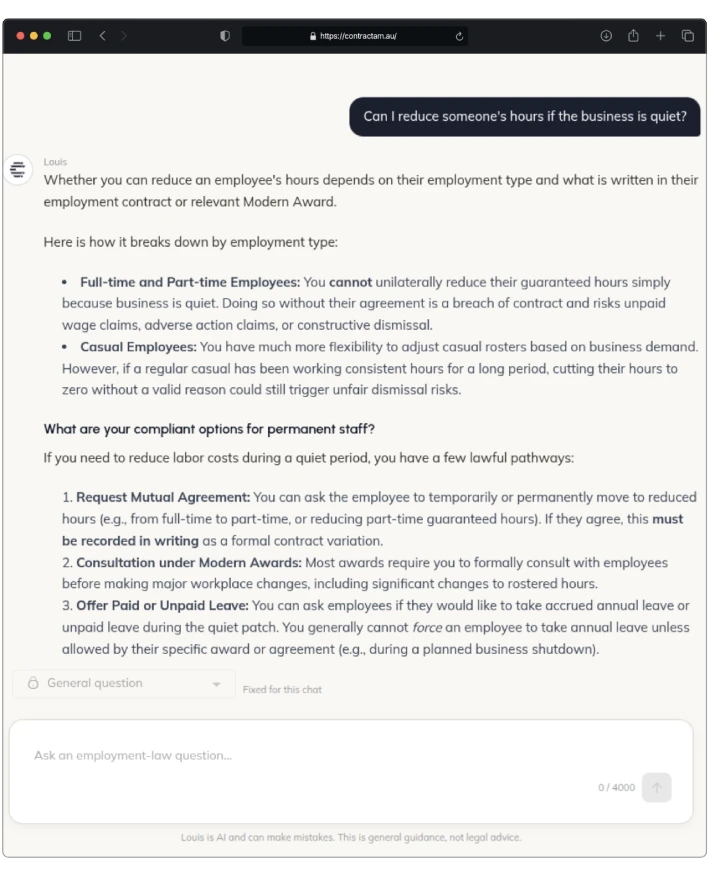
Before you end an engagement, change someone's hours, or move a casual across. Louis tells you what the law requires, and where it's silent.
What you can ask before you move
Before you let someone go — The minimum employment period is 6 months, or 12 in a business with fewer than 15 employees. He'll tell you which one applies here.
Before you change the terms — Hours, duties, location. What the contract allows, and what the Modern Award sets underneath it.
When he won't answer — Some of it turns on facts he can't see from the document. Those go to a lawyer, and he says so rather than guessing.
Every contract kept.
Every version of it.
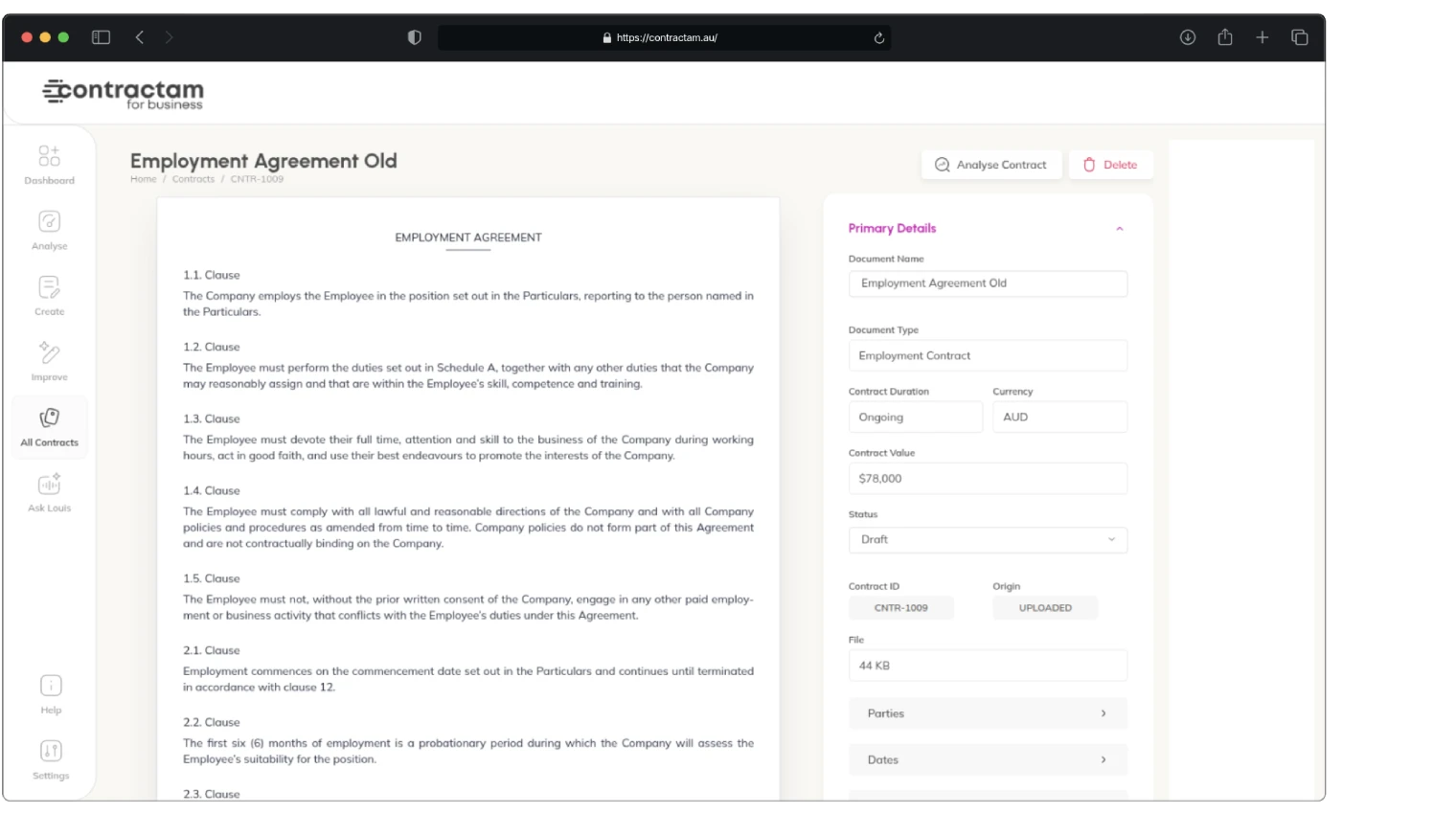
Employee records have to be kept for seven years under the Fair Work Regulations 2009 (Cth). Every contract, and every version signed, sits in one place.
What stays on file
Seven years, without a filing system — Every contract kept and findable for as long as the records have to exist.
The version they actually signed — Not the current template. The document that person agreed to, on the date they agreed to it.
Ready when someone asks — An audit, a claim, or a request from the person themselves. One search, not a hunt through email.
Before you issue the next one
-
We've already got contracts out there. Do I have to redo them all?
No. Upload them as they are and you get back which ones need changing and which clause in each. In most cases it's a handful of clauses, not a rewrite, and the ones that are fine come back marked as fine.
-
Can it tell me which Award applies to us?
It checks the contract against the Award covering the role and flags where the classification doesn't match the duties described. Where coverage itself is genuinely unclear — a mixed role, a new kind of business — it says so instead of picking one.
-
What if the role isn't covered by an Award?
Award-free doesn't mean rule-free. The National Employment Standards still apply, and so do the rules on notice, leave and termination. The contract is checked against those, and against the high income threshold where it's relevant.
-
Does it keep up with casual conversion?
Casual employment has changed more than once since 2024. Contracts are checked against the definition and the conversion pathway in force now, not the version a template was built on.
-
Can the rest of the team use it, or just me?
More than one person can work in the same account, and every contract stays in the same place regardless of who uploaded it. The person who left doesn't take the file with them.
Can’t find the answer to your question?
Contact us and we’ll get back to you as soon as we can.