


Stop waiting
on contract approvals.
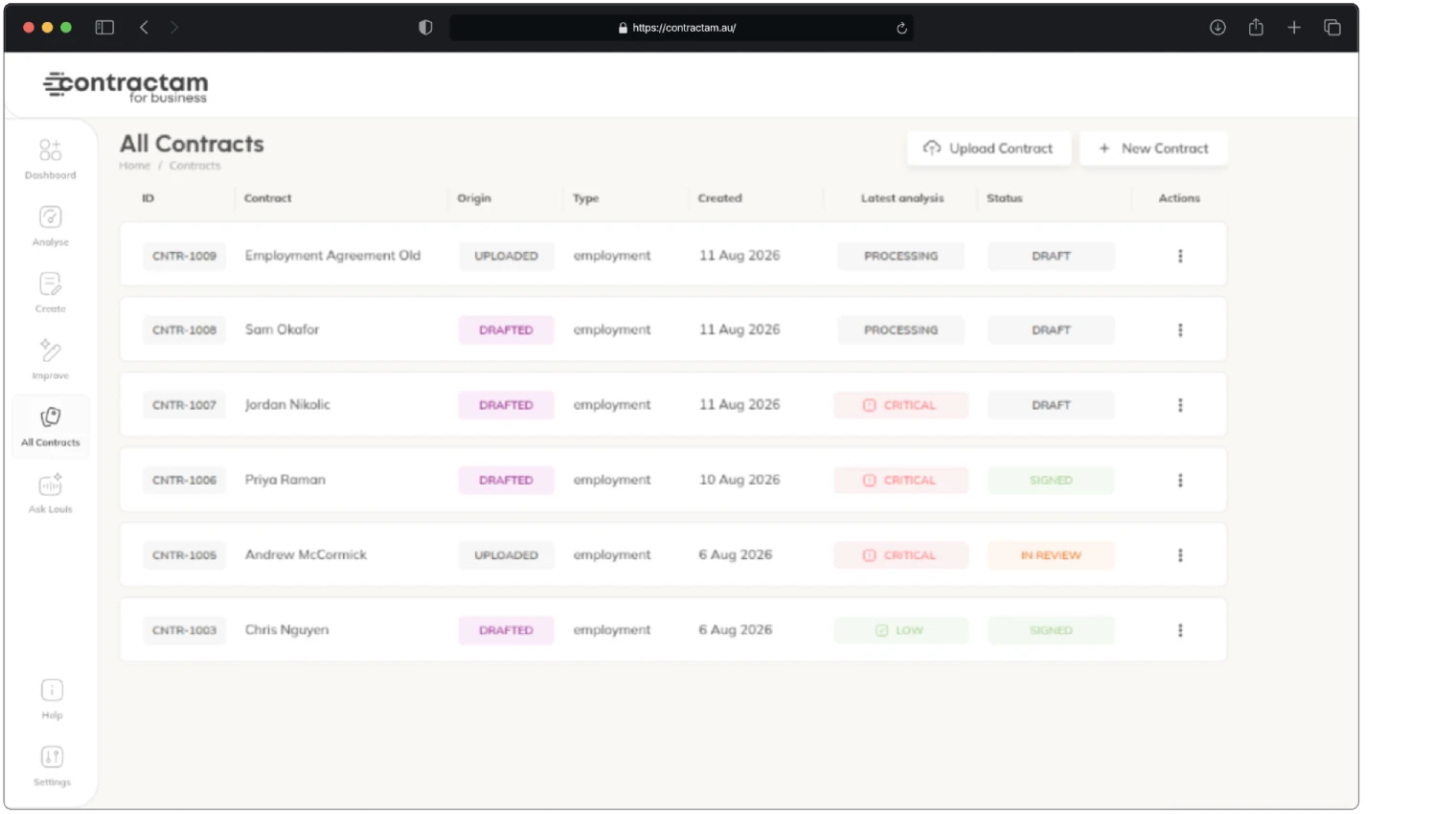
Keep your business moving. Empower your ops team to review supplier agreements and commercial leases in minutes, clearing the bottleneck while keeping the business protected.
Analyse a contractIncluding the ones signed before you got here.
Ask about any contract
without opening it.
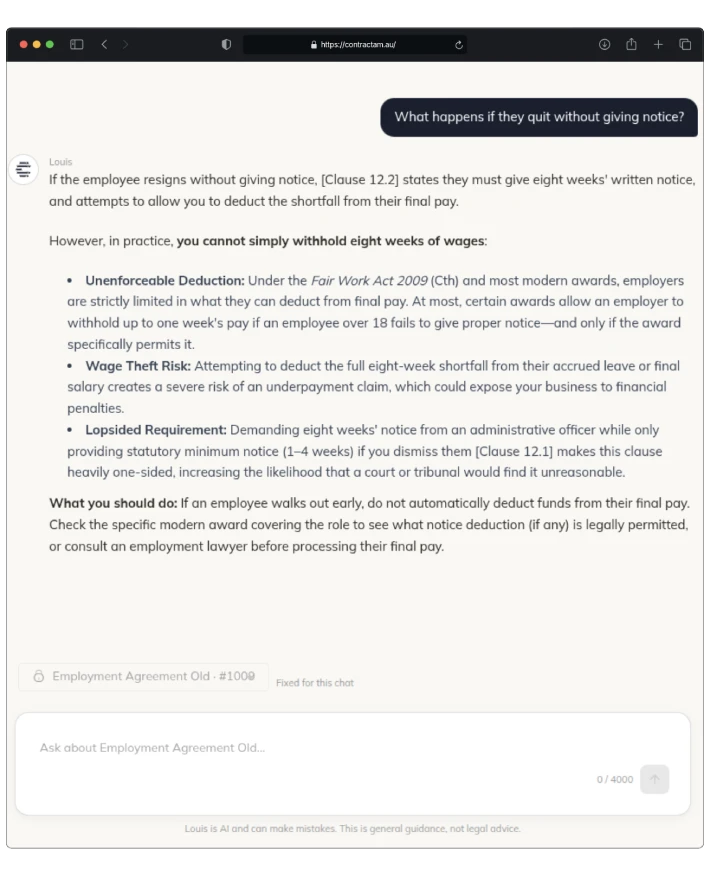
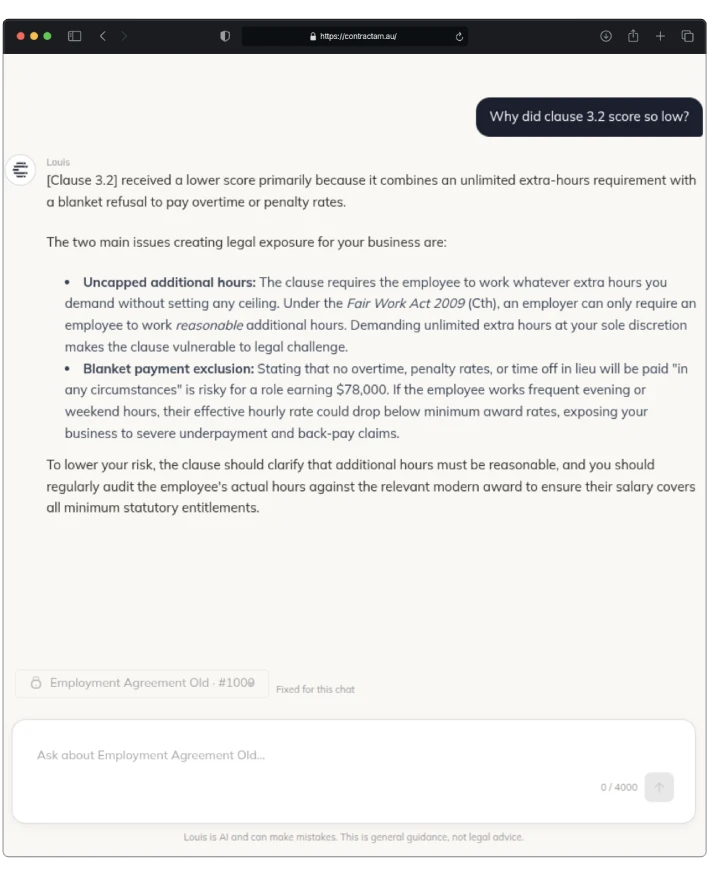
Louis has read every agreement in the hub. Ask what clause 14 commits you to, or which supplier terms renew before December.
What you can ask him
Where the risk actually sits — Ask which agreements carry the most exposure, and which clause in each one puts it there.
Before you sign or renew anything — Ask what it locks you into, what notice it takes to get out, and where the exposure sits. Before, not after.
When you need to get out of one — The notice period, what it costs to break, and what has to happen before you can. Straight from the contract you signed.
Know what can go wrong
before it does.
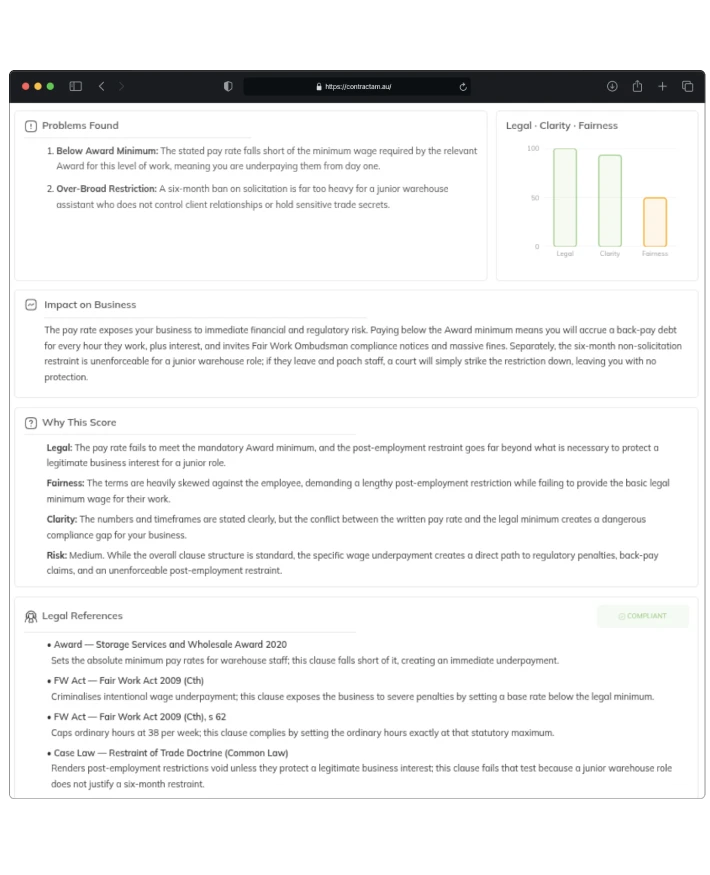
Every contract is read clause by clause and scored against the Act that governs it. An NDA, a sales agreement and a lease each fail in different ways.
What comes back
The clause that causes the problem — Named, with what it exposes you to and what it's measured against.
Different contracts, different failures — An NDA with a restraint that may not hold. Sales terms with an unfair term in them. A lease with an option window that passes quietly.
Ready for the lawyer, if it needs one — The clauses already flagged and cited, so the conversation starts where the problem is.
Bring a draft,
not a description of one.
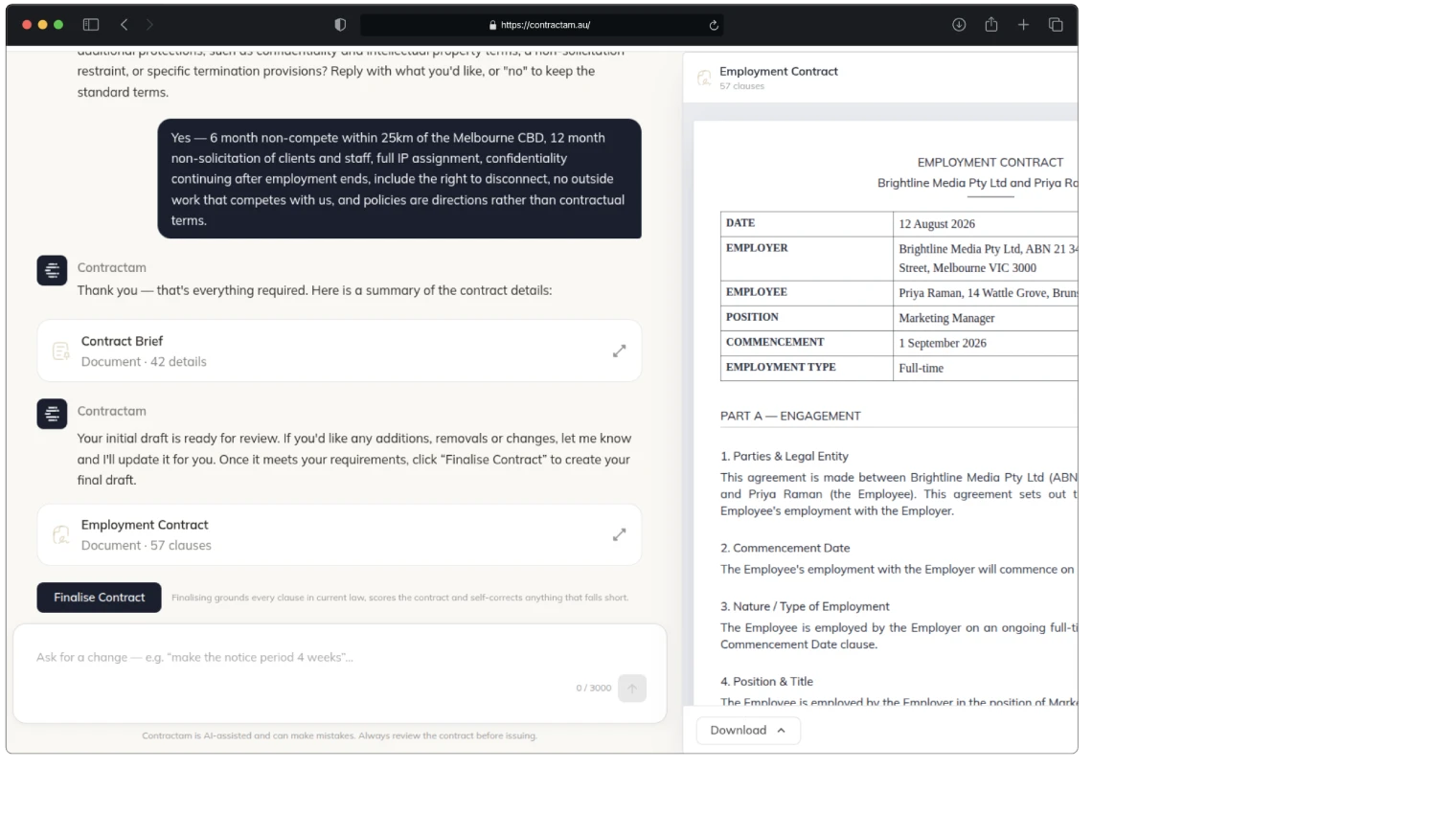
Answer plain questions about what the agreement is for and who it involves. The clauses are written against the Australian law that governs it, before anyone else sees it.
What you take to them
Something on paper, not a conversation — The terms are written down before the first meeting, so the discussion starts from a document.
Built for the type it is — A supplier agreement, an NDA and a lease each get the clauses their own law requires.
Yours to change — Every clause is editable. It comes back as a Word file as well as a PDF, not a locked document.
Ask what happens
before it happens.
Run the situation before you agree to the terms. What the contract does if they miss a delivery, if the price moves, or if the site closes early.
What you can run through
If they don't deliver — What the contract entitles you to, and what it quietly doesn't.
If the price moves — Indexation, review clauses, and what you've already agreed to accept.
What to ask for instead — A narrower version of the clause, so you go in with a position rather than an objection.
Before you put the first one in
-
Our contracts are in email, a shared drive and someone's filing cabinet. How do they get in there?
You upload them. There's no order to do it in and no minimum — each one is read and scored as it lands, so you can start with the ten that matter and add the rest later.
-
Half of them were signed before I started. Is that a problem?
Those are the ones worth doing first. A contract you didn't negotiate still binds the business, and knowing what's in it before the next renewal or review is the whole point.
-
We lease in three states. Does it handle that?
Retail tenancy runs on a different Act in every state and territory — eight regimes in total — and each lease is read against the one that applies where the site is. Tasmania is the one most tools get wrong: the Act passed there in 2022 has never commenced.
-
Our suppliers won't change their standard terms. What's the point of finding them?
Fair. Most won't move on clause 1. But knowing which clause is the problem tells you what to price for, what to ask for elsewhere, and what to watch if it's ever relied on. And an unfair term in a standard form contract doesn't become fair because someone signed it — that's what the unfair contract terms regime in the Australian Consumer Law exists for.
-
What do I actually get back?
Every clause scored, the ones that fail the law named first, and the reason attached to each. The contract stays in the hub with its analysis, so the next person who opens it sees the same thing you did.
Can’t find the answer to your question?
Contact us and we’ll get back to you as soon as we can.