


An AI contract expert,
always on your side.
Never navigate a contract alone. Ask Louis to analyse a hidden risk, draft a new term, or run the scenario on what happens if you break a contract. Your digital assistant handles the heavy lifting instantly, turning complex jargon into plain English so you always know your exact position.
Ask LouisHe'll also tell you plainly when a scenario needs a human lawyer.
Contract analysis and information, not legal advice.
You don't need
the legal word for it.
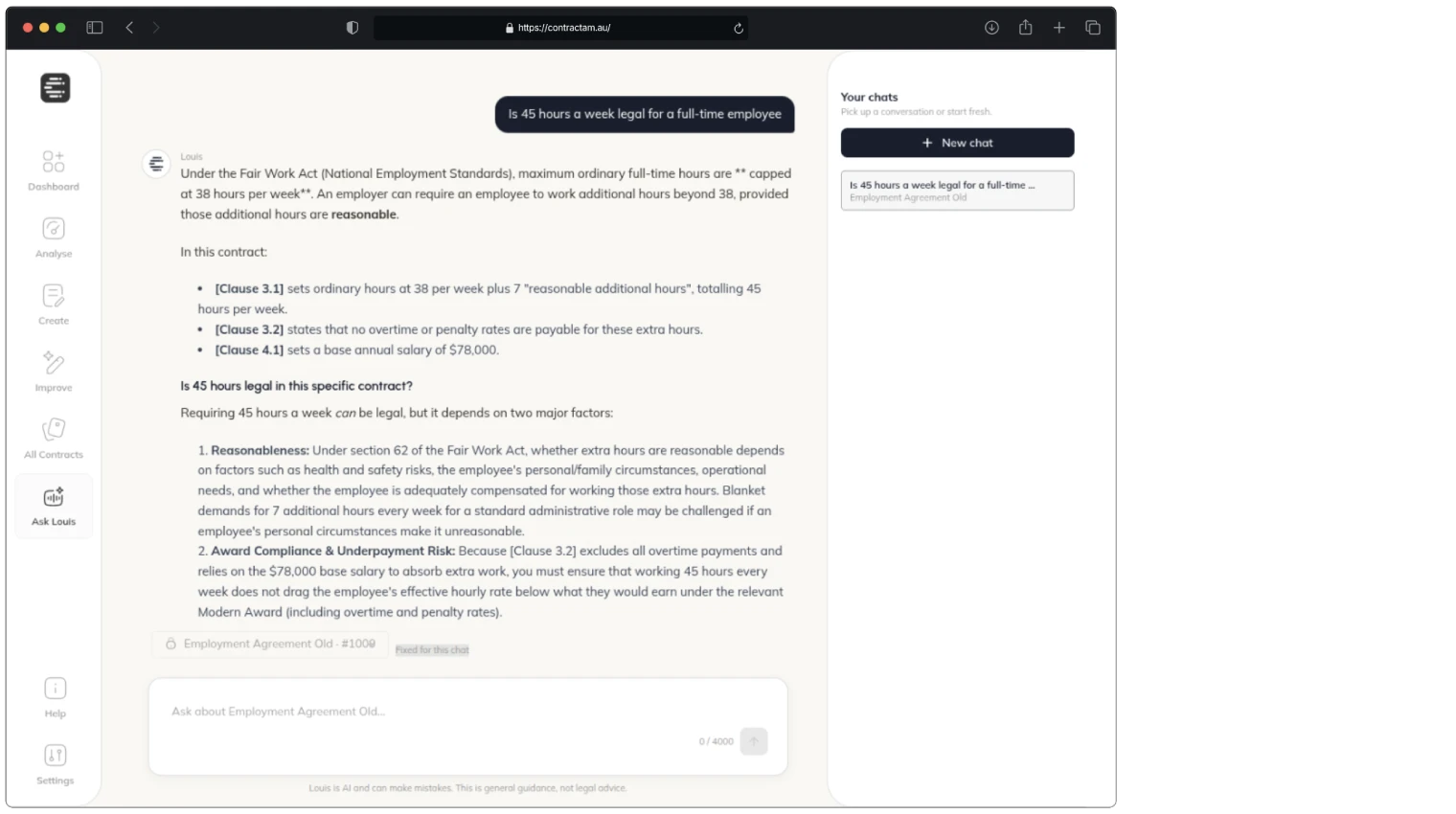
Type the question the way you'd say it out loud. Louis works out which clause you mean, and which part of the law decides it.
Ask it however it comes out
No legal term needed - Ask "can I change their hours later?" and he finds the clause that answers it.
One clause, or the whole document - "Is clause 8 normal?" works. So does "what's the worst thing in this lease?"
He remembers what you asked - Follow-up questions stay on the same contract. You don't explain the document twice.
He already knows
what scored 41.
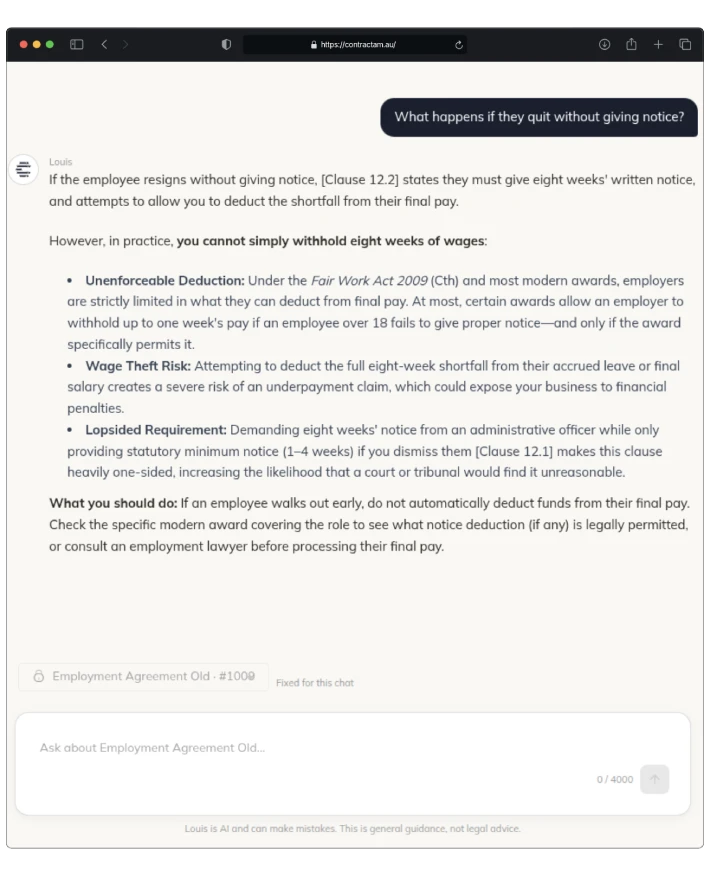
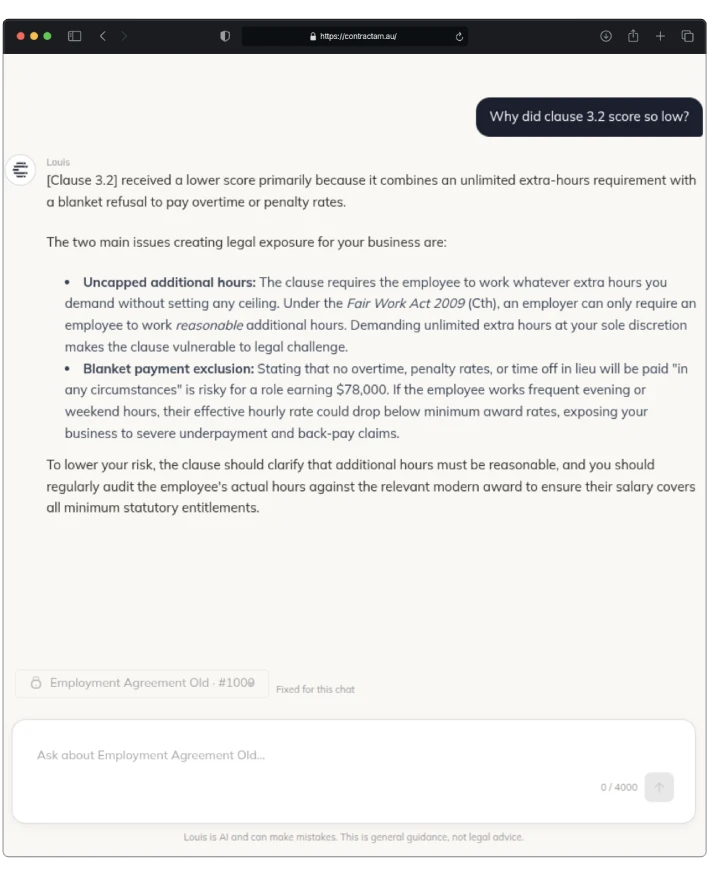
Open a chat on a contract you've analysed and the scores come with it. He answers about clause 8.2 in your document, not about restraint clauses in general.
Answers built on your wording
He quotes the clause back - The answer points at what your contract actually says, not at an example of what one might say.
The scores are already in the chat - Legal compliance, fairness and clarity travel into the conversation with the contract.
He won't invent a clause that isn't there - If your contract is silent on something, he says so instead of filling the gap.
Ask before there's
a contract to read.
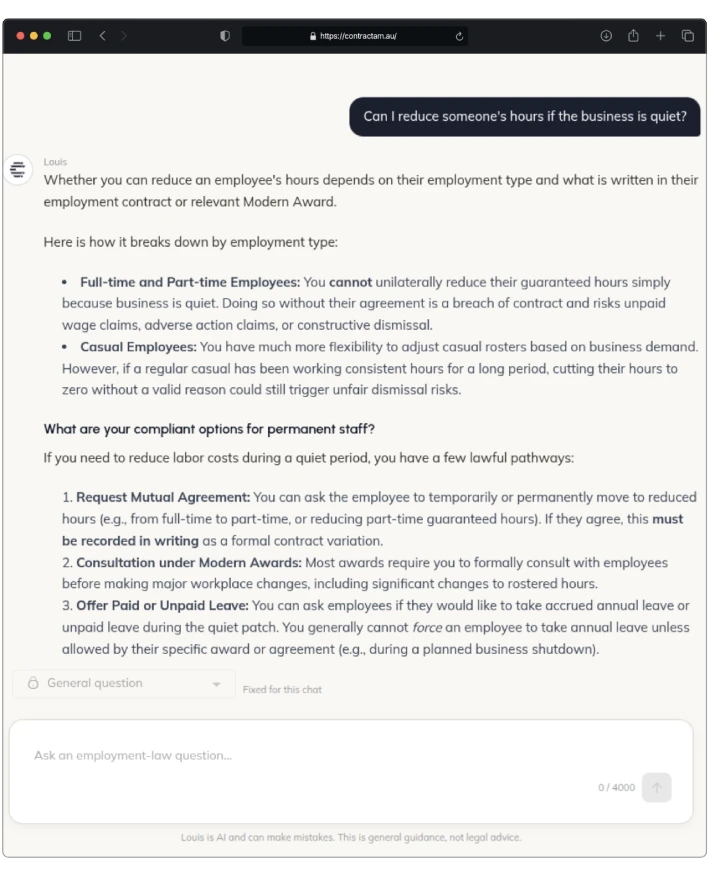
You don't need a document open. Ask what the law requires for what you're about to send, and you get the floor before you commit to anything above it.
The floor, before you commit
What the minimum actually is - He tells you the notice period the law sets for that length of service. What you offer above it is yours to decide.
Which rules apply to this one - An employment offer sits under the Fair Work Act 2009 (Cth). A contractor engagement can sit under the Independent Contractors Act 2006 (Cth).
He says when it turns on facts - Some questions can't be answered from the document alone. Those are the ones that go to a lawyer.
The answer moves
when the law does.
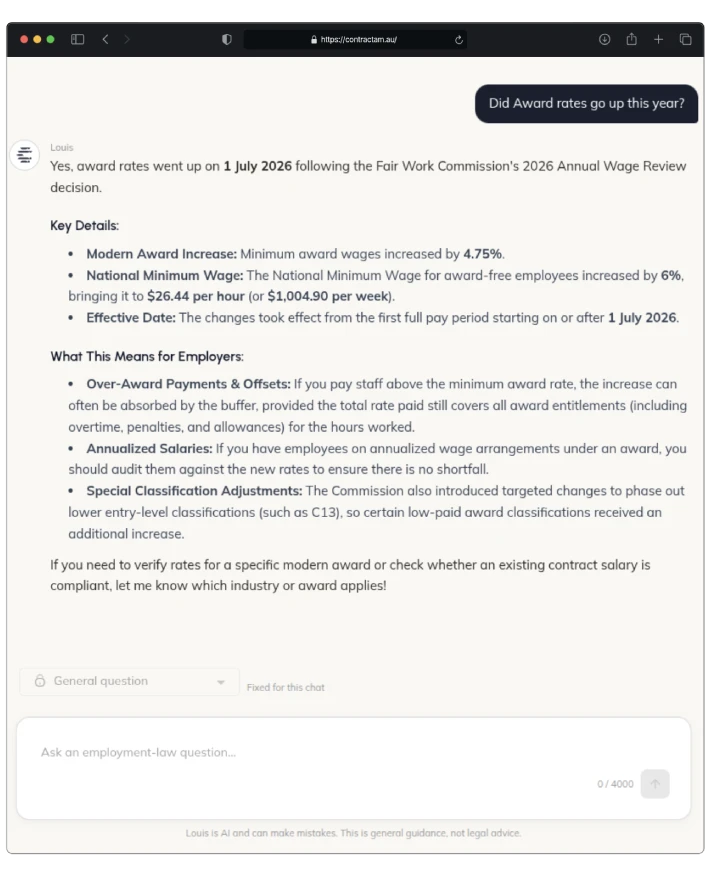
Award rates change on 1 July. Superannuation rules changed in 2026. He answers on the version of the law that applies now, not the one a template was built on.
Australian law only, and current
The rate that applies now - He answers on the Modern Award rate in force today, not the one written into a contract two years ago.
He won't quote a law that never started - Tasmania passed a retail leases Act in 2022 that has never commenced. Retail tenancies there still run on 1998 Regulations.
Announced is not the same as law - A ban on non-competes was announced in the 2025–26 Budget. It is not law, and is proposed to start in 2027.
The answer comes back
in the words you asked in.
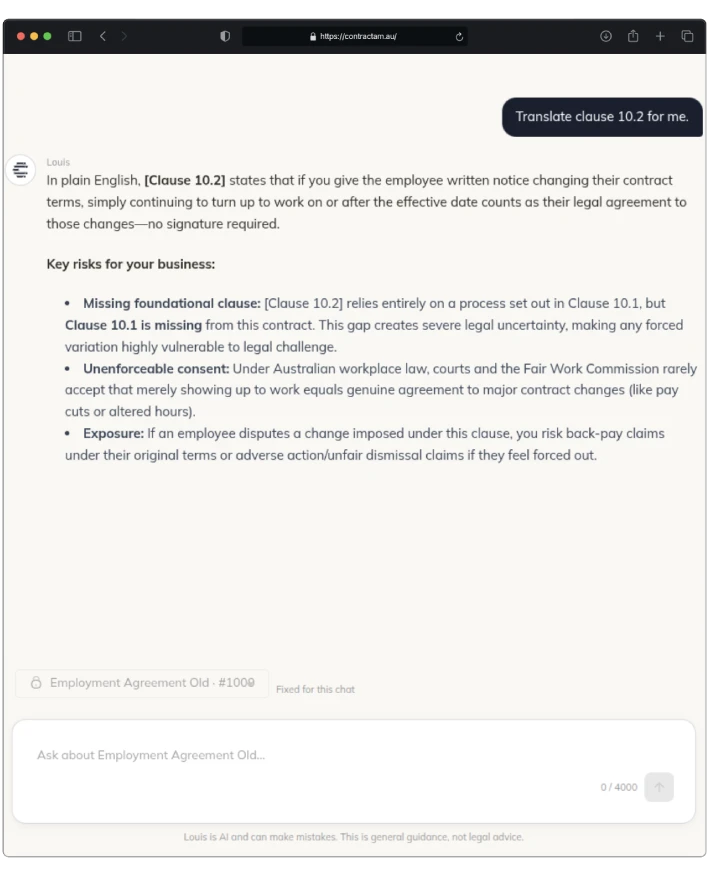
He doesn't repeat the clause at you. He tells you what it does, and where it sits against the law that governs it.
No second translation needed
The clause, then what it does - He shows the wording, then says what it means in a sentence you don't read twice.
He'll show you the narrower version - Ask what a clause would look like shorter or tighter and he sets the two side by side.
A few lines, not pages - He answers short by default. Ask him to go deeper and he will.
Before you ask him anything
-
What can I actually ask him?
Anything about a contract you've uploaded - what a clause means, why it scored what it scored, what the law requires on that point, what a narrower version would look like. You can also ask with no document open: what notice period applies to eleven months of service, which Act covers a contractor engagement, what a Modern Award sets for a casual on a Sunday.
-
Does he know my contract, or just contracts in general?
Both, and he tells you which one he's doing. Open a chat on a contract you've analysed and he answers from that document - its wording, its scores, its flags. With nothing open, he answers on the law itself.
-
Can I ask him about a contract someone sent me?
Yes. A lease from an agent, a supplier's standard terms, a contractor agreement drafted by the other side - upload it and he answers on it the same way. He reads what's in front of him, whoever wrote it.
-
Can he change a clause, or only explain it?
He shows you what a narrower version looks like, next to the one you have, so you can see the difference. Changing the contract itself happens in Improvement. In the chat he explains and shows; the rewrite is a separate step you approve.
-
What won't he answer?
General legal questions are fine - what the law requires, what an Act covers, what the minimum is. What he won't do is answer something that turns on facts the document can't show him: what was said in the interview, what's been happening on site, whether a dispute is worth running. On those he says the same thing every time: “That one needs a lawyer. It turns on facts I can't see from the document.”
Can’t find the answer to your question?
Contact us and we’ll get back to you as soon as we can.