


Draft your next contract instantly.
From standard employment contracts to complex commercial agreements. Answer a few simple questions and let the AI generate a solid first draft based on current Australian standards, tailored exactly to your needs.
Build a contractReady to review as an editable Word file.
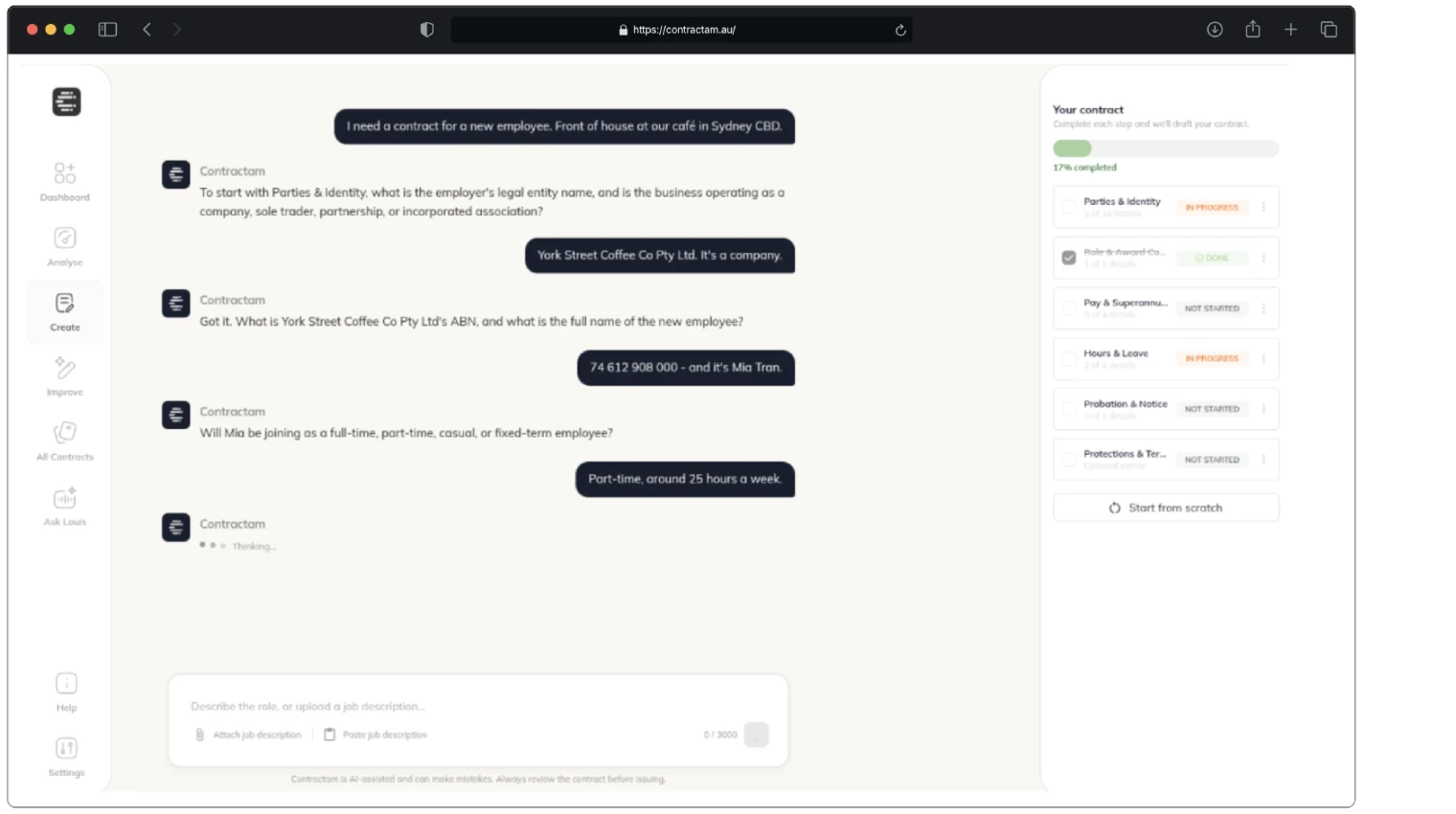
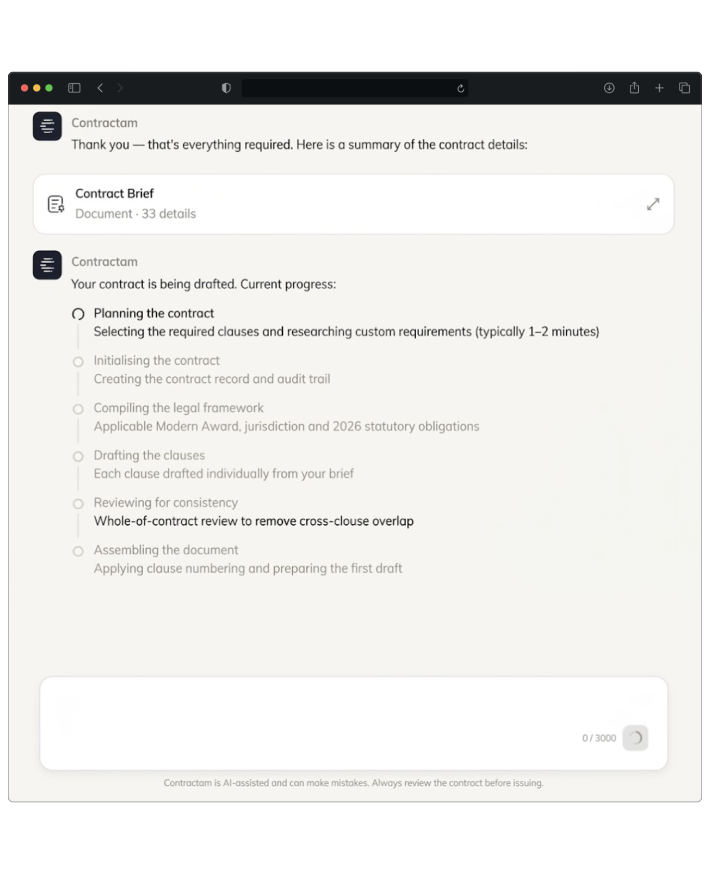
Answer the questions.
The engine writes the clauses.
Plain questions about what the contract is for and who it involves. Nothing to draft, nothing to look up, and no legal wording on your side of it.
Nothing to prepare
Questions, not a blank document - What the work is, who is doing it, and where it happens. No clause library to pick from.
It drafts for the state, not just the country - A restraint in a New South Wales agreement can be read down by a court under the Restraints of Trade Act 1976 (NSW). In Victoria the same words are more likely to be struck out entirely.
It corrects you as you go - Put in a number that sits below the legal minimum for that arrangement and it fixes it, then tells you why.
A café and a construction site
don't sign the same contract.
The contract type is only half of it. What the work actually involves decides which clauses have to be in there, and which numbers they carry.
Written for the work it covers
Rates that change on 1 July - Award rates are pulled the day you build the contract, not the day someone last saved the template.
The clauses that only exist in your trade - Site inductions, licences, tools, travel. A construction agreement carries terms a café one never needs.
A retail lease is not a commercial lease - Retail tenancy legislation in most states requires a disclosure statement before signing. A commercial lease carries no such obligation.
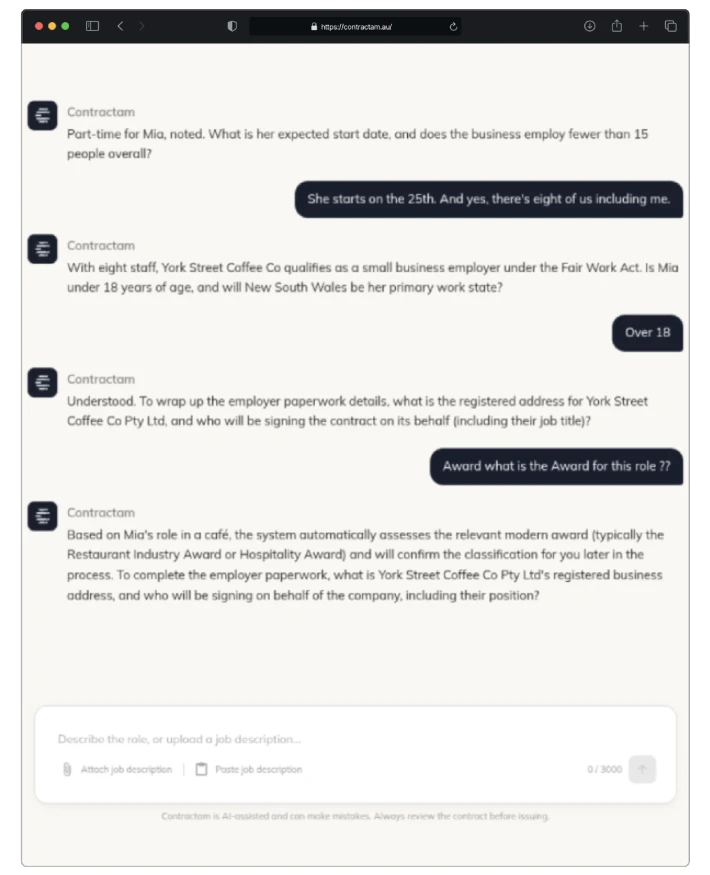
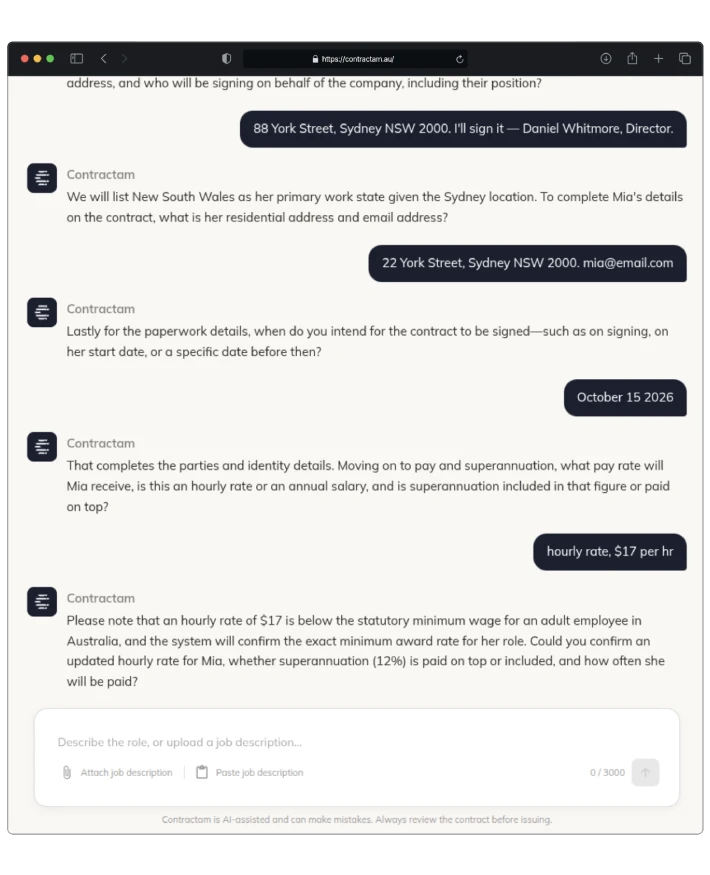
It can't write a clause
that sits below the law.
Every contract type has a minimum underneath it that no agreement can go under, no matter what both sides sign. The draft is built up from that line, not edited back down to it.
The floor comes first
The minimum nobody can sign away - Employment terms are written against the Fair Work Act 2009 (Cth) and the National Employment Standards. A clause that goes under them has no effect, even if both sides agreed.
A contractor agreement that doesn't read as employment - Section 357 of that Act deals with sham contracting. The terms are drafted so the arrangement holds up as what you called it.
It checks itself before you see it - The contract is audited up to three times inside the engine. The last check happens before the draft reaches your screen.
Nothing gets left out
because nobody thought of it.
Most contracts don't fail on the clause that's wrong. They fail on the one that was never in there, and that only becomes obvious at the point you need it.
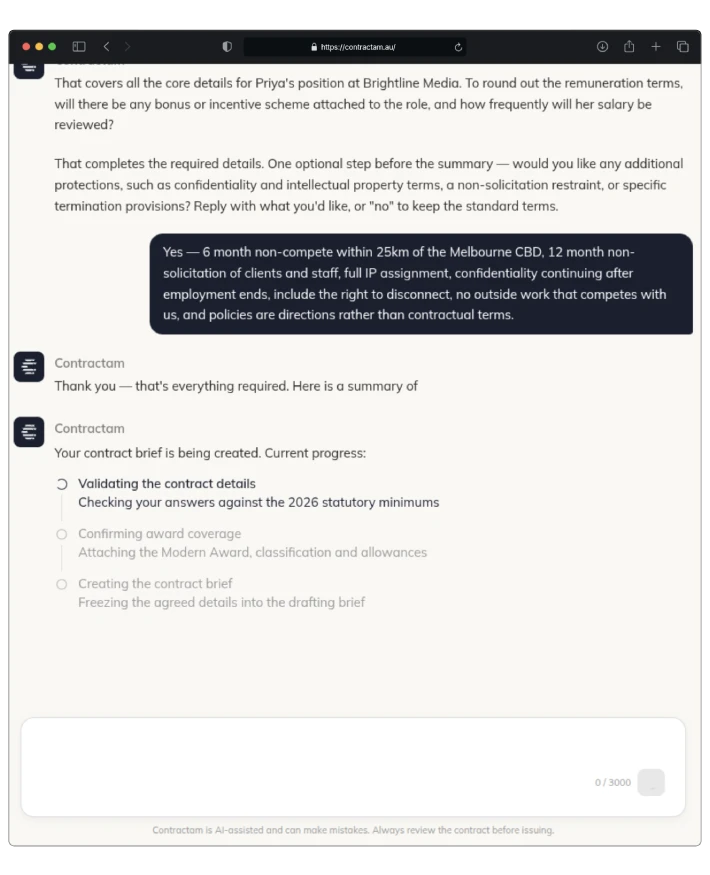
Written in from the start
Who owns the work - Under the Copyright Act 1968 (Cth) a contractor keeps copyright in what they produce unless the contract assigns it. The assignment goes in.
Confidentiality that outlasts the person - Obligations that keep running after the engagement ends, rather than stopping the day someone hands back the laptop.
A restraint drafted to be defensible - Term and area sized to the actual role. A restraint with no limit on either is the one a court is most likely to refuse.
A finished contract,
not a starting point.
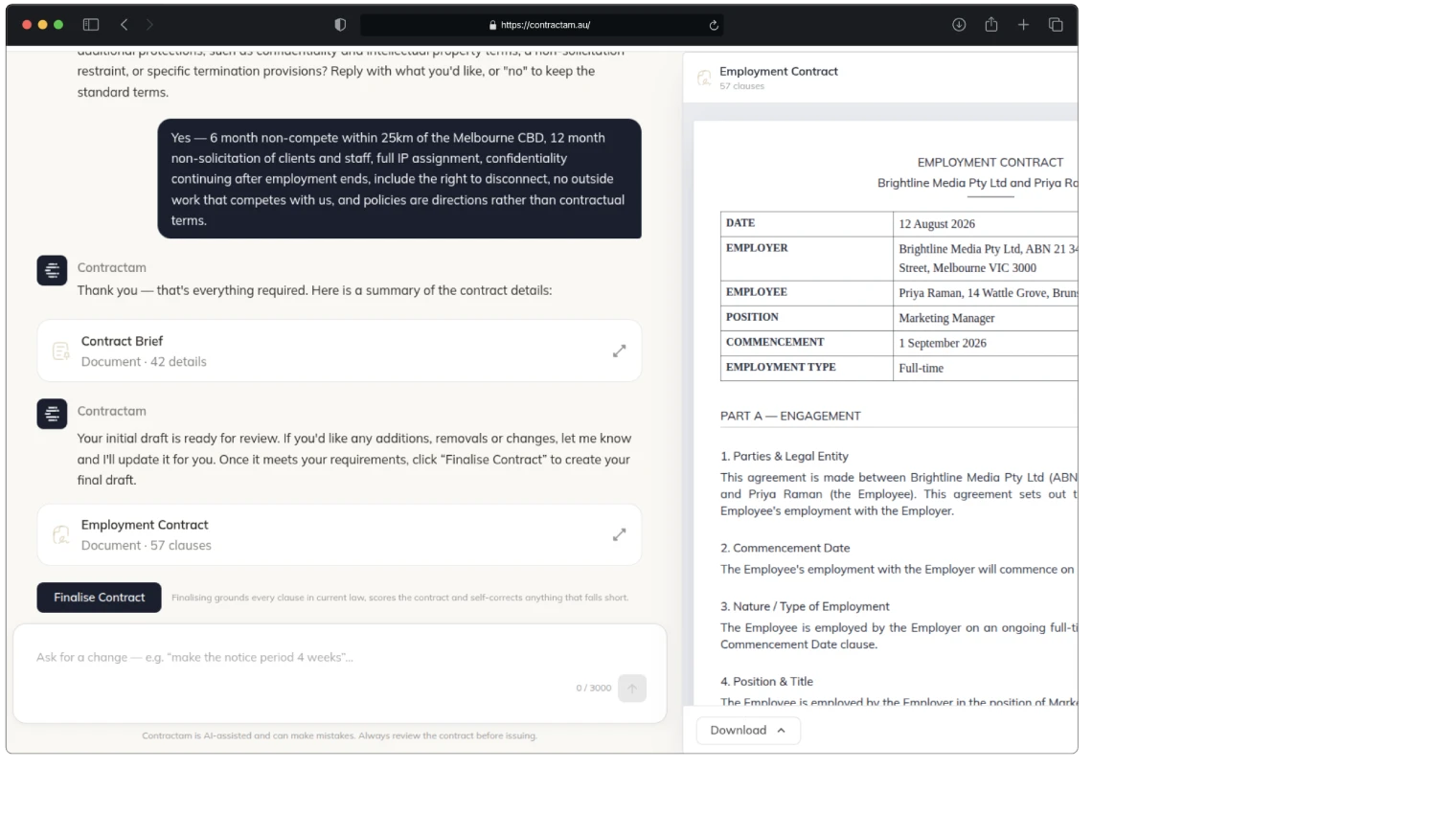
What comes back is not a template with gaps in it. It is the whole agreement - every clause written in full, every number already in place, formatted and ready to sign.
Complete to the signature block
Parties, dates, rates and schedules are filled in from your answers. Nothing sits in square brackets, and nothing is left for you to look up afterwards.
Structured like a lawyer's document
Definitions, numbered clauses, schedules and execution blocks, in the order a lawyer expects to find them. The other side's adviser has nothing unusual to slow them down.
A PDF to send, a Word file to keep
The same contract in both formats. Send the PDF exactly as it is, or open the Word file and adjust whatever you want before it goes out.
Before you send the first one
-
I'm not a lawyer. How do I know I answered the questions correctly?
The questions ask about the work, not the law - what the person does, the hours, where it happens. If an answer would produce a clause below the legal minimum, the engine corrects the number and tells you why before the draft is built.
-
Can I change the contract after it's built?
Yes. You get an editable Word file, not a locked document. Change whatever you like - the only thing worth knowing is that a clause you rewrite by hand is a clause the engine hasn't scored.
-
My situation isn't standard. Will it cope?
Sometimes not, and it will tell you. Louis, your AI contract assistant, flags anything that turns on facts he can't see from the document. That's the point where a lawyer is the right call, and it's better to find out before you send it.
-
Do I have to start again for the next one?
No. Build it once, then change the role, the rate and the start date. Everything is checked again against the law as it stands that day, not the day you first built it.
-
Can I still have my lawyer look at it?
Yes, and it's a good idea for anything unusual. What changes is what lands on their desk. They start from a contract that's already been checked clause by clause, with the ones that need a decision flagged, rather than from a blank page or an old template.
Can’t find the answer to your question?
Contact us and we’ll get back to you as soon as we can.