


Total control over every agreement.
Stop losing track of critical documents. Bring your employment contracts, NDAs, and commercial leases into one secure register, with every file evaluated against current Australian standards.
View contract registerTrack status, history, and hidden risks in one place.
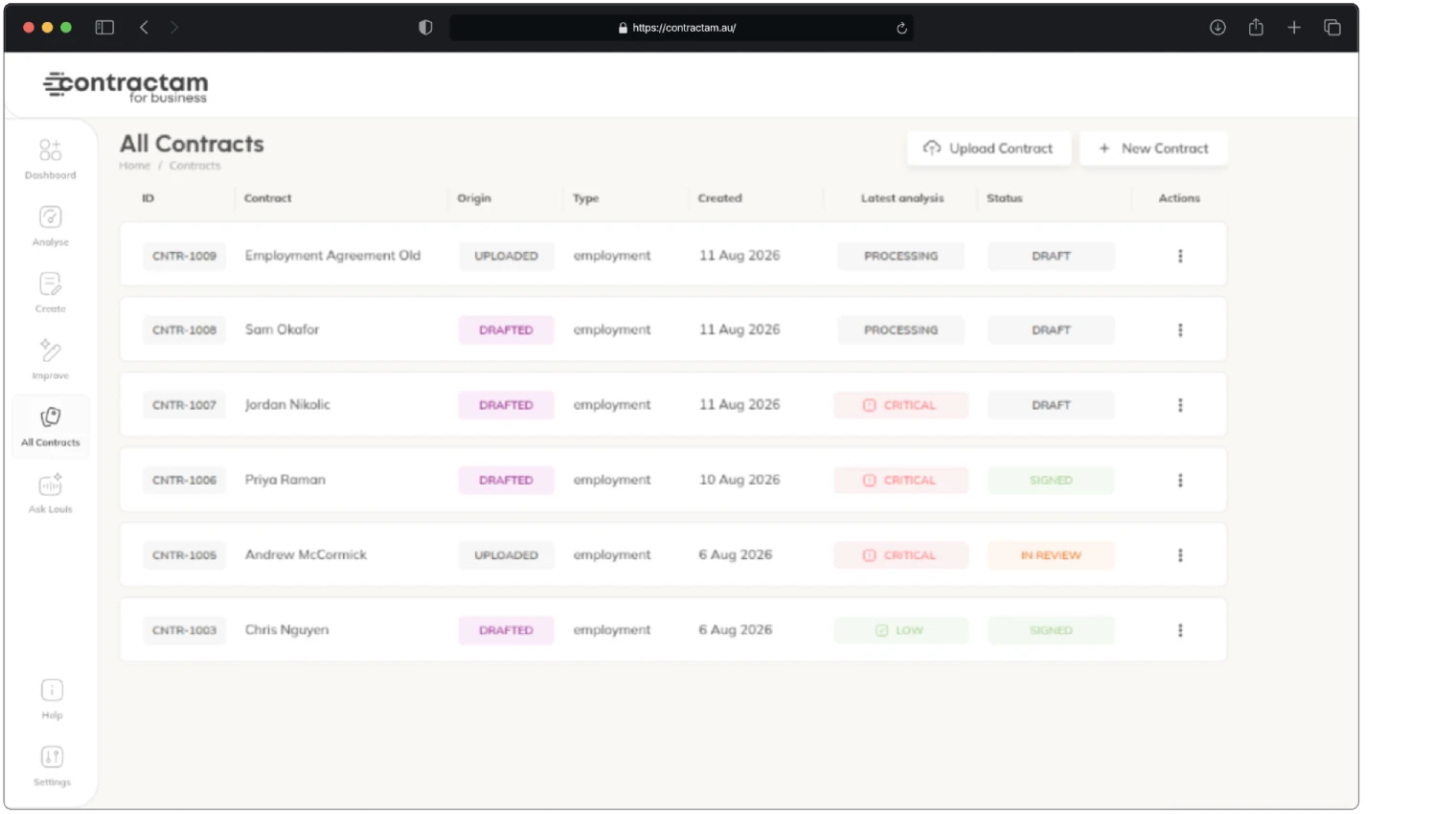
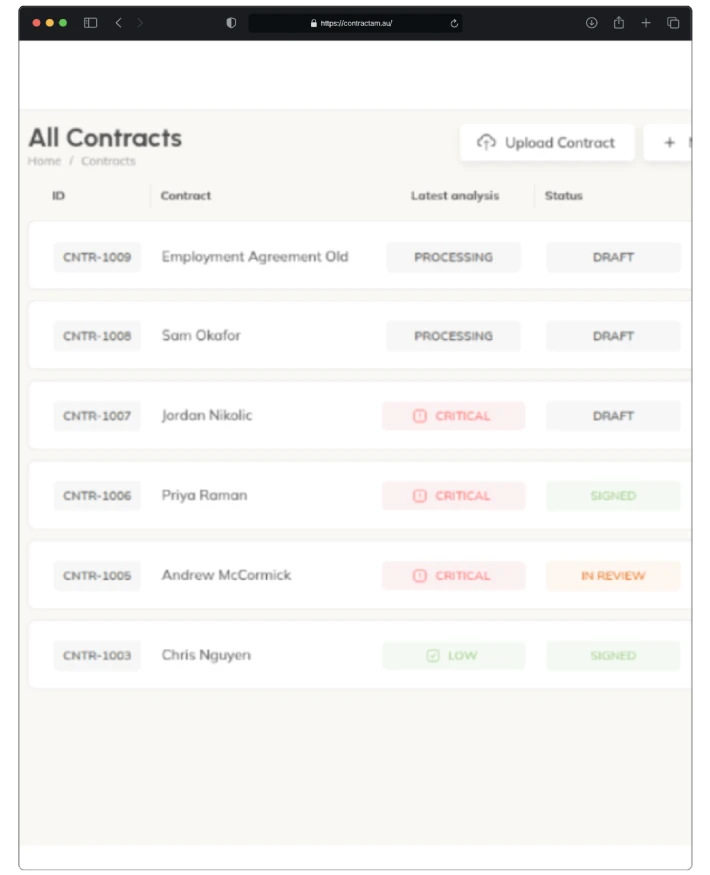
Nobody has to ask
which one is current.
Signed contracts end up in email threads, shared drives, and somebody's downloads folder. The version that was actually signed is rarely the one that's easiest to find.
One register, current versions
The signed version, not the third draft - Each contract keeps its own history. The one you open is the one that's in force.
Everything sits with the contract it belongs to - The analysis, the compliance report, the PDF and the Word file. Not spread across four places.
It doesn't leave when the person does - When whoever sent the contract moves on, the contract and everything attached to it stays where it is.
You can tell
without opening one.
Every contract in the register carries where it got to. Draft, sent, signed, archived - visible in the row, before you open anything.
Status on every row
Where each one stopped - Drafted, sent, signed or archived. The status sits on the contract, not in somebody's memory of the conversation.
The ones still waiting on someone - An offer letter sent eleven days ago and never returned tends to surface on the start date. Here it surfaces before then.
Ended, but not gone - Employee records have to be kept for seven years under the Fair Work Regulations 2009 (Cth). Archived contracts stay in the register and stay searchable.
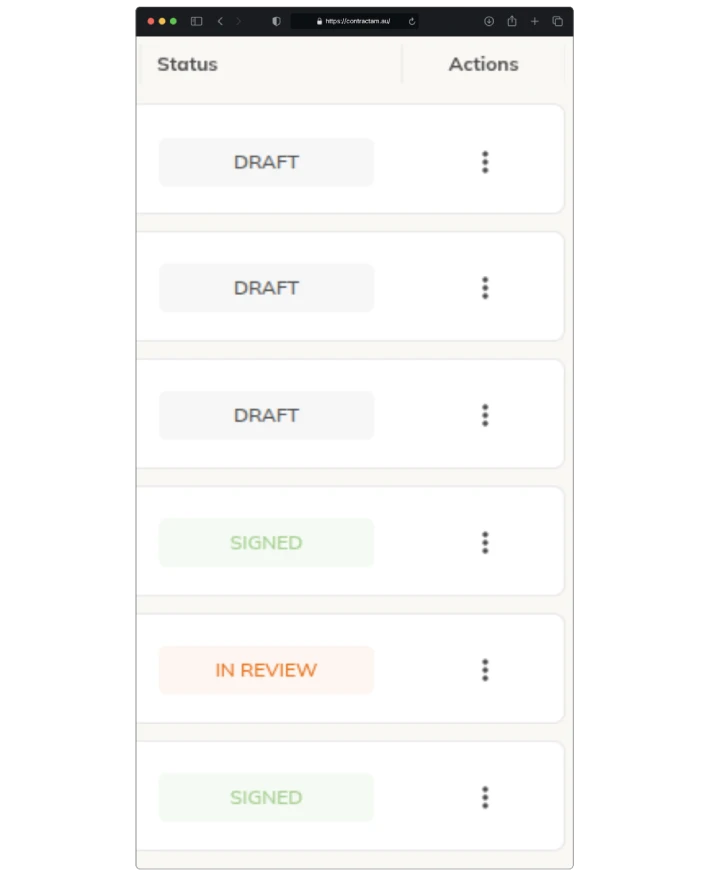
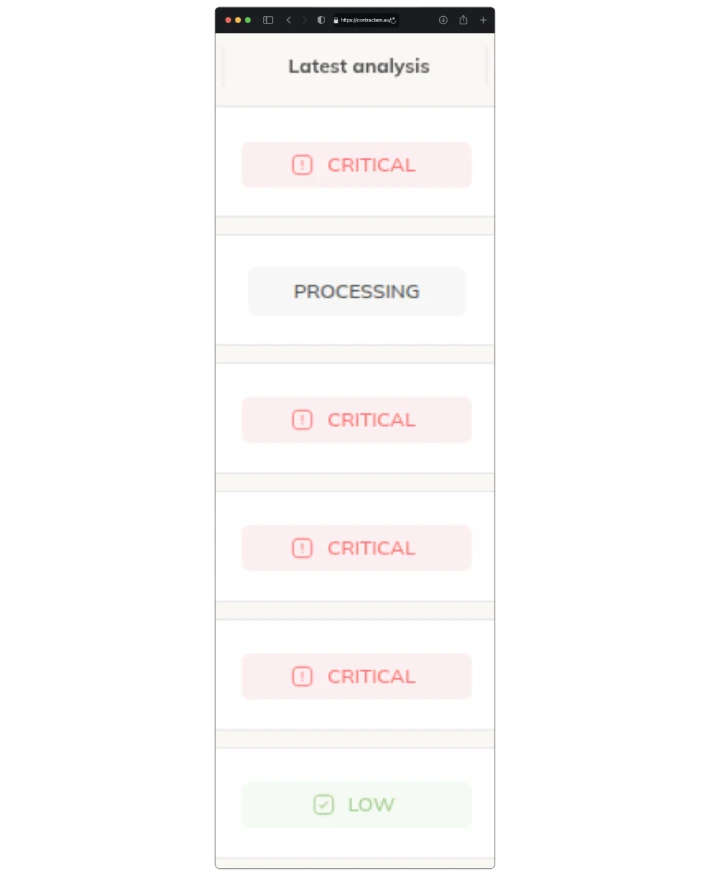
The risky ones
are already marked.
Every contract in the register carries the scores it was given. You don't open a contract to find out whether it's a problem - you open it because it is one.
Three scores on every contract
Legal compliance, pass or fail - Checked against the Act that governs that document. A shop lease in South Australia is read against the Retail and Commercial Leases Act 1995 (SA), not a national rule.
Fairness and clarity, out of 100 - Two scores on every clause, so the register sorts by the ones most likely to be argued about.
The same clause, across every contract that has it - A term that's wrong in the template is wrong in each contract built from it. The register shows all of them together, not one at a time.
Every detail,
already extracted.
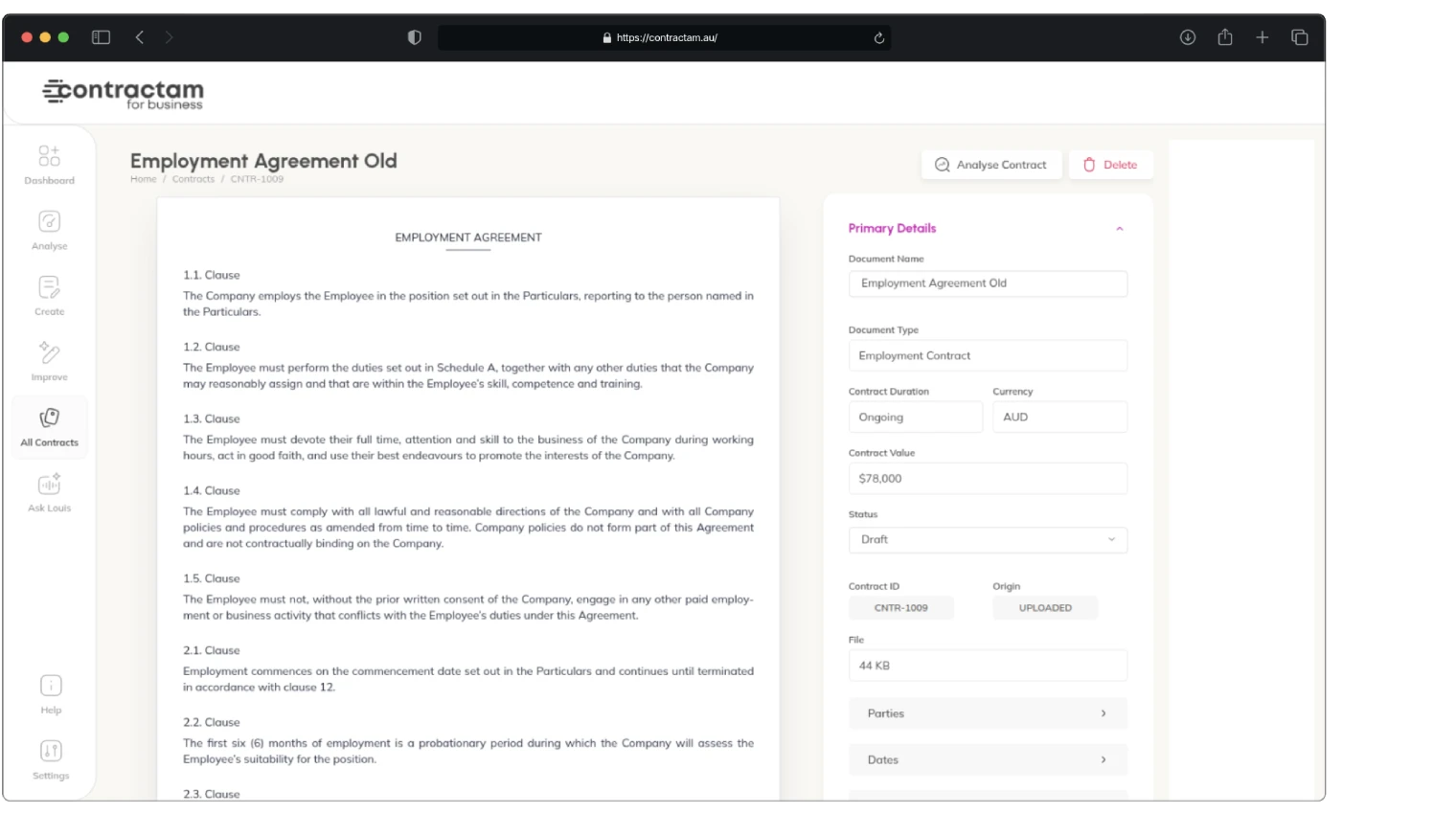
Open a contract and the reading has been done. The document sits clause by clause on one side, and everything pulled from it on the other.
Clause by clause, not a PDF scroll
The agreement is broken into its numbered clauses and laid out in order, so you read the term you came for instead of scrolling a scan to find it.
The details, lifted into fields
Type, duration, value, currency and status sit beside the document — extracted from the text itself, not typed in by whoever uploaded it.
Parties, dates and history together
Who the agreement is between and the dates written into it, held on the same screen as the document they come from — with a fresh analysis one click away.
Before you put everything in one place
-
Does this replace our shared drive?
For contracts, yes. A drive holds files and gives you a folder name to search. This holds what's inside them - the clauses, the scores and the dates - so you can find a contract by what it says rather than by what someone called it.
-
How do the contracts we already have get in there?
You upload them, and you can do it in bulk rather than one at a time. Each one is read and scored as it lands, so the register is useful the same day rather than after a month of tidying.
-
Someone always ends up editing a contract outside the system. How do we know which one is current?
The version you upload last is the one marked current, and the earlier ones stay underneath it rather than disappearing. You can see what changed and when. Each contract also carries where it got to - drafted, sent, signed or archived - so the status travels with the document.
-
Is anything in our contracts used to train the AI?
No. A contract is read, scored and then held for you. It isn't fed back into a model, and it isn't used to improve one. Documents are encrypted in transit and at rest.
-
Who else can see what's in there?
Only the people you give access to. Contracts hold salaries, termination terms and commercial rates, so it's worth deciding who needs to be in there before anyone is invited.
Can’t find the answer to your question?
Contact us and we’ll get back to you as soon as we can.