


Control your risk.
Protect your business.
You can't read every line of every contract, but our Australian AI can. Spot hidden risks, unfair terms, and costly traps before they impact your bottom line.
Analyse a contractAnd if it still needs a lawyer, you'll know exactly which clauses to ask about.
Know what's inside it
in 5 minutes.
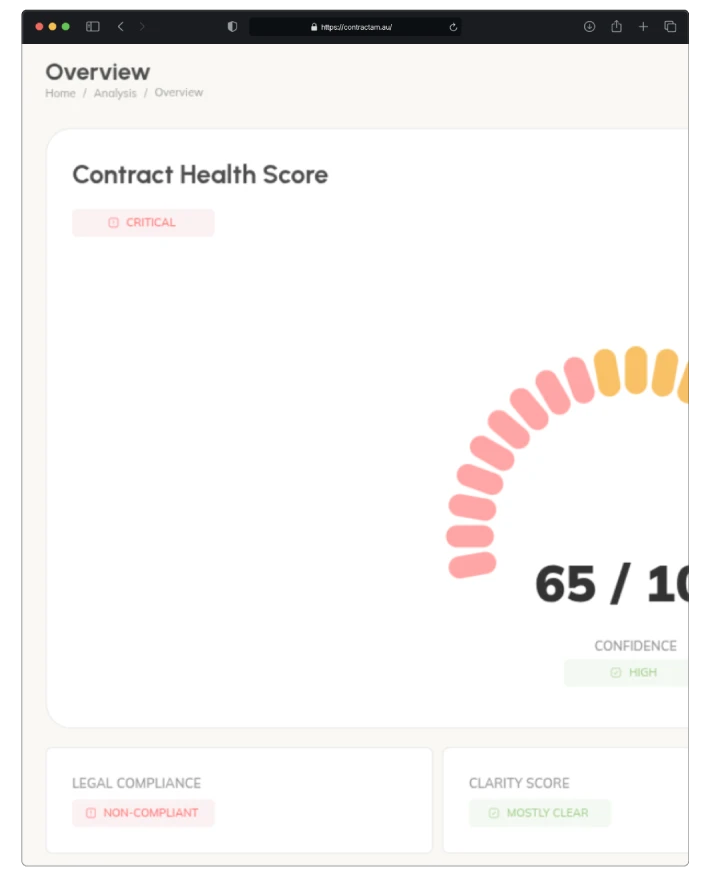
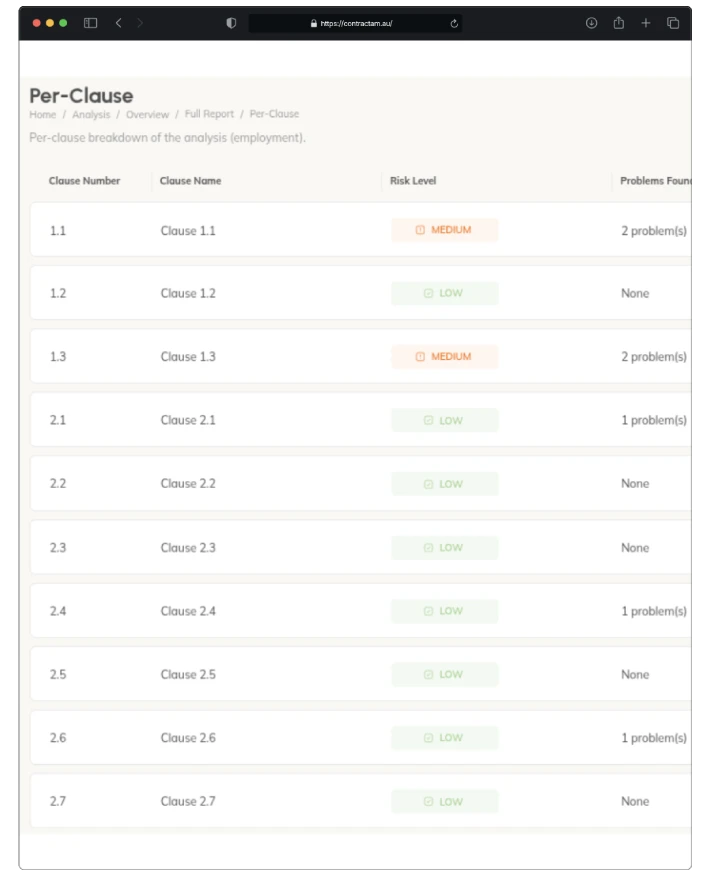
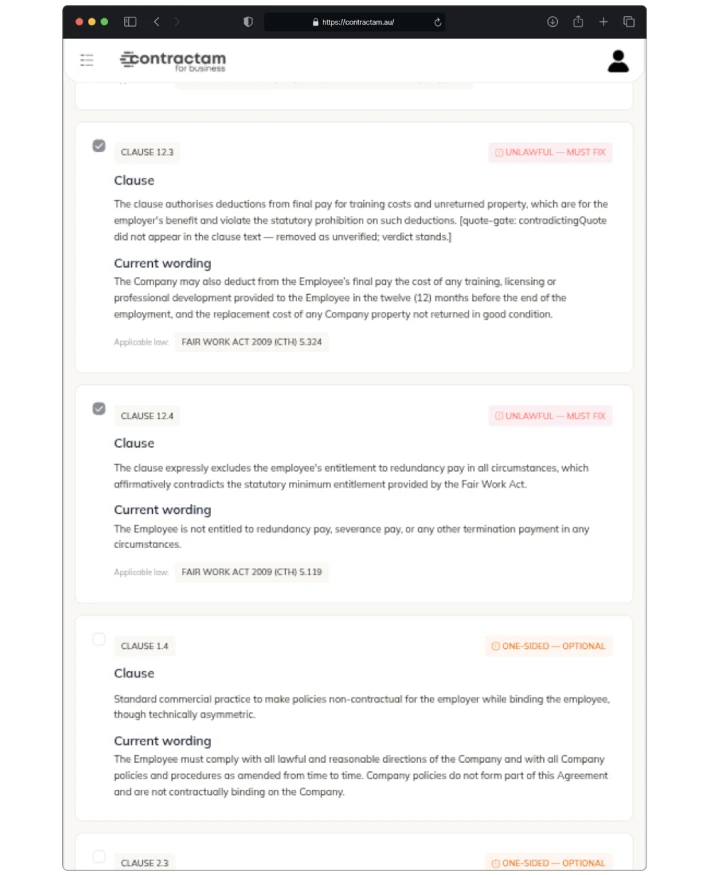
Upload the contract. It comes back scored clause by clause, with the ones that fail the law at the top.
What you get back
Plain English, not clause language — Every clause explained in a sentence, in the words you'd use yourself.
What each clause exposes you to — The rate, the penalty, the commitment — named on the clause it sits in, not buried at the end.
What to deal with first — Ranked by what has to change, what's worth negotiating, and what can stay. Not 40 flags of equal weight.
Know what to ask
before you get there.
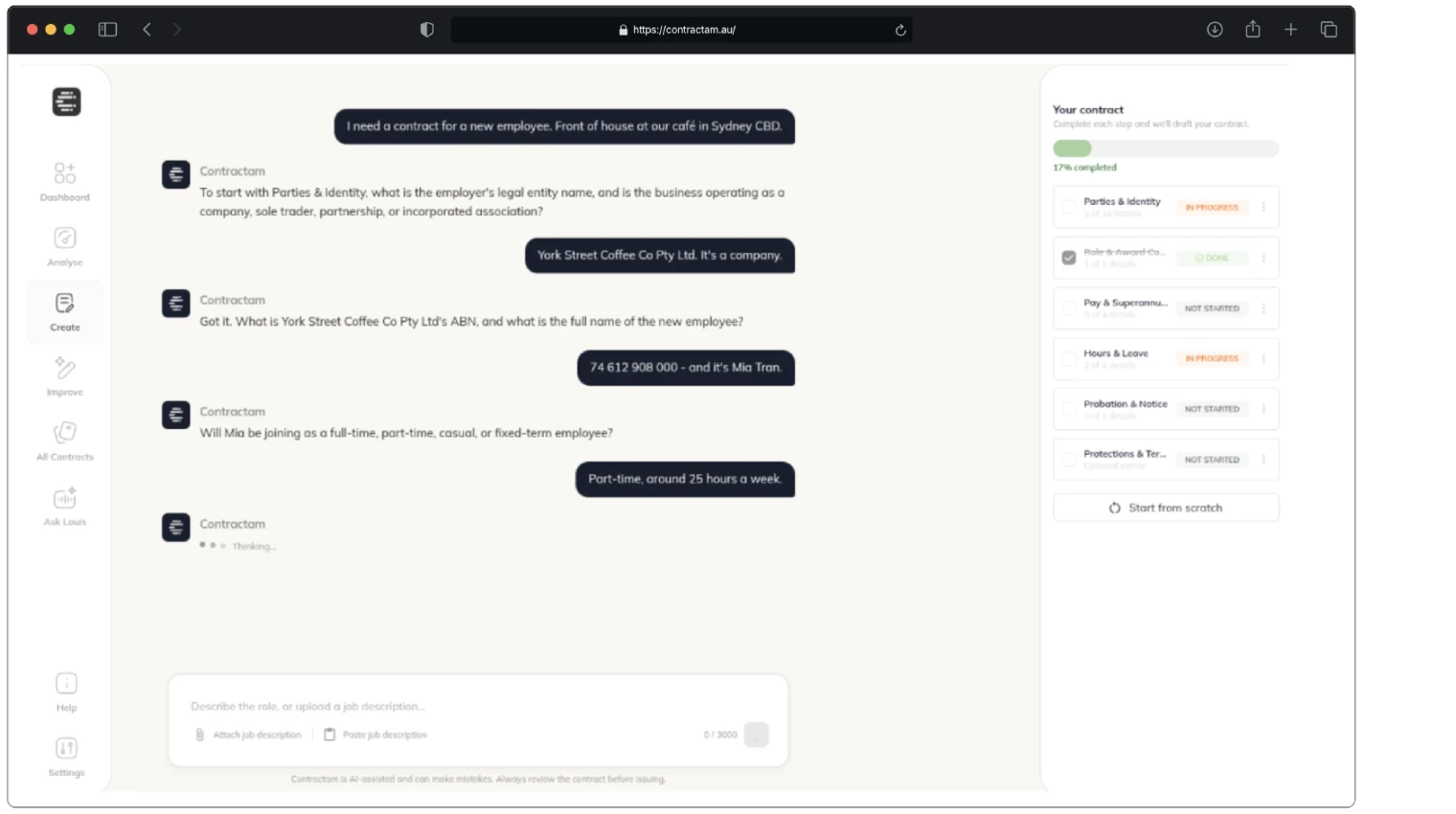
You still send it to your lawyer. You send it with the clauses already flagged, the law already cited, and the questions already narrowed.
What you bring with you
The clauses, already named — The conversation starts at clause 8 and the Act it fails, not at page one.
What breaches the law, and what's just unfavourable — Two different lists. Only one of them is a legal question.
Which contracts need one at all — Not every contract does. The ones that do come back marked, with the reason.
Know what
it can cost you.
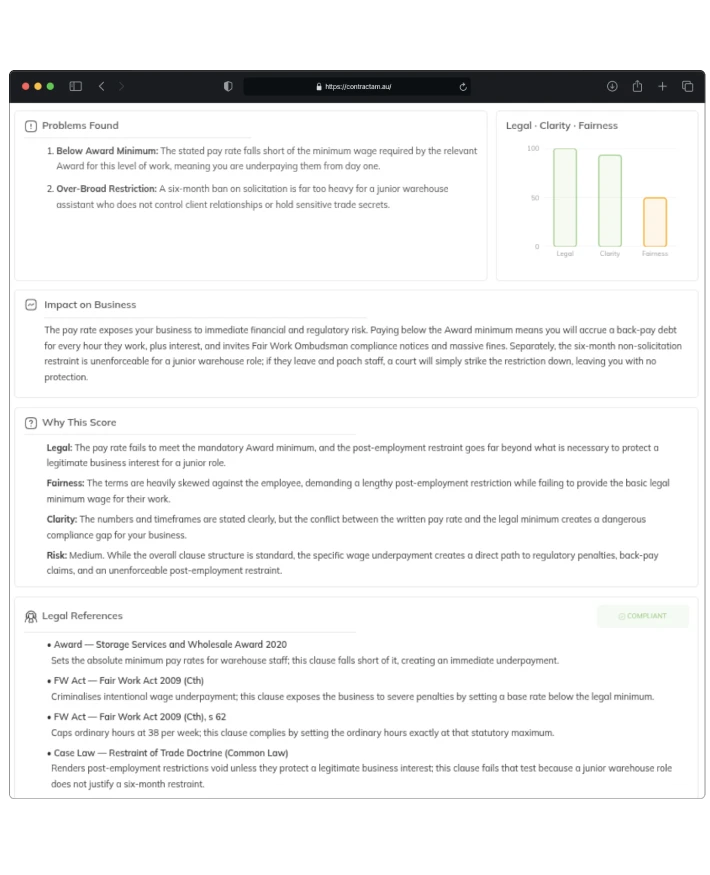
Every clause is read against the Act that governs it. What comes back is the exposure each one carries, named on the clause it sits in.
Where it actually hurts
Money you have to pay back — An underpaid rate or missed superannuation repeats every pay run until someone finds it. Then it's owed for all of them.
A penalty on top of it — Unfair terms in your own standard contracts carry civil penalties under the Australian Consumer Law. Proposing one already counts as a contravention.
Protection that doesn't hold — The restraint and the confidentiality clause you're relying on are the ones most likely to fail when they're finally tested.
Negotiate with AI
on your side of the table.
Most contracts get signed exactly as they arrived. Not because the terms were fair, but because pushing back takes time and wording nobody has on hand.
How it helps you negotiate
You know what's worth raising — The points that matter come back ranked, so you're not arguing everything at once.
You have the words ready — Each point comes with what to ask for, written out. Nothing to draft yourself.
You don't have to sound unreasonable — Every ask is measured against the law, so it lands as a standard rather than a demand.
Before you put a contract through it
-
I'm not a lawyer. How do I know it got it right?
Every flag comes with the Act and the section it's measured against, so you can check it yourself or hand it to someone who can. The engine audits its own output before you see it. And where a question turns on facts the document can't show, it says so rather than guessing.
-
What kinds of contracts can I put through it?
Employment agreements, contractor and services agreements, NDAs, supplier and service terms, and commercial and retail leases. Each is read against the Australian law that governs that type, not against one general contract standard.
-
Can it write the contract, or only check one?
Both. Answer plain questions about what the contract is for and who it involves, and the clauses are written against the Australian law that governs it — employment, contractor, NDA, supplier or lease. It comes back as a PDF and an editable Word file, ready to send.
-
What if the contract is mostly fine but a few clauses aren't?
Those clauses come back with a rewritten version beside the original, so you can see exactly what changed and why. A restraint that runs too long comes back as a step-down version, drafted to be defensible. Nothing is changed until you approve it.
-
What if I've already signed it?
Put it through anyway. You can't unsign it, but you'll know what's in it before the renewal, the review, or the conversation you're about to have. A term you find now is an amendment. The same term found later is a dispute.
Can’t find the answer to your question?
Contact us and we’ll get back to you as soon as we can.