


They promised it by email, but it isn't in the contract. Does it count?

Yes. An email can be evidence of what you bought or why you bought it. If your signed order includes the supplier’s proposal, a promise in that proposal may already be part of the deal. Even if the promise stayed in your inbox, it can still be evidence of misleading and deceptive conduct. Start with the documents both sides agreed to, then check exactly what the salesperson told you.
Suppose you asked whether the software could send invoices straight to your accounting system. The salesperson wrote back, “Yes, that’s included.” You chose their quote because your bookkeeper spends every Friday afternoon entering invoices. Now the supplier wants an extra fee for the connection.
If you’re wondering whether a verbal agreement is legally binding, the same distinction matters. A call can produce an agreement. It can also give you a reason to buy something the supplier never agreed to deliver.
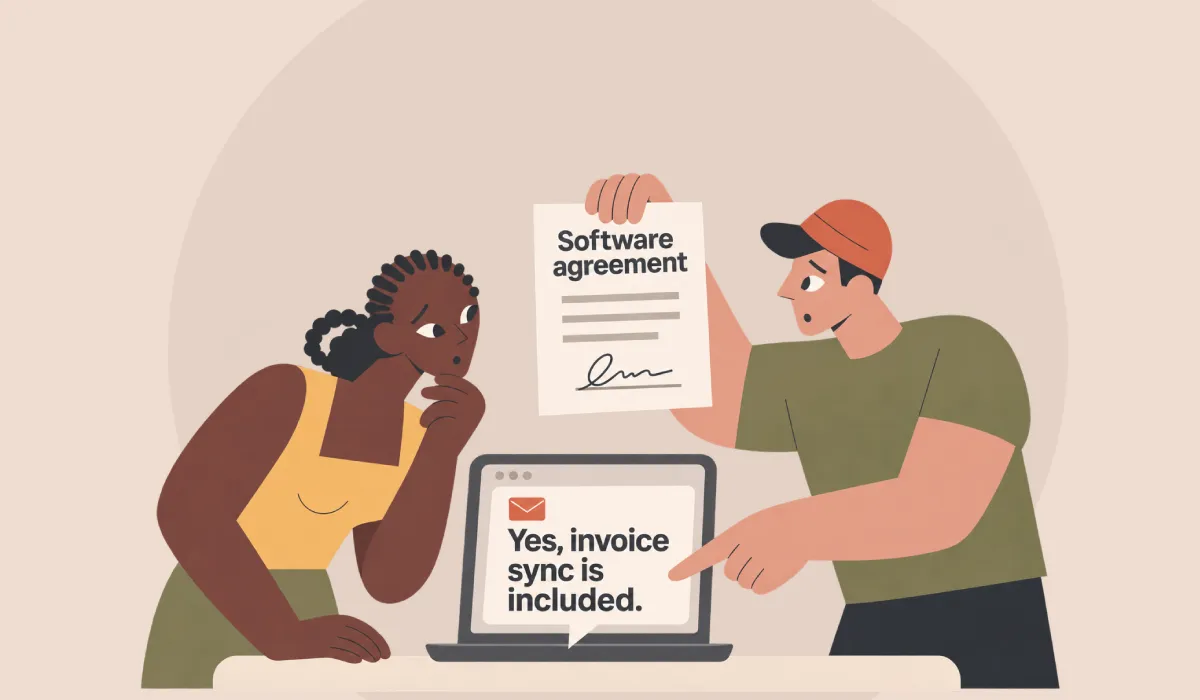
Two questions, not one
| Question | What to look for | Why it matters |
|---|---|---|
| What did the supplier agree to deliver? | The signed order, documents it includes, and any other evidence of what both sides agreed. | If the supplier failed to perform a binding promise when required, you may have a breach of contract. |
| What impression did the supplier create before you signed? | The full email exchange, proposal, demo and any qualification or correction you received. | A misleading sales claim can matter even if the promise never became a term. |
Both questions can apply to the same email. The first might be answered by a single line in the order form. For the second, the words immediately before the sales rep’s “yes” can be just as important. Did you ask whether a connection exists, or whether it comes with this subscription?
When an email or verbal agreement becomes part of the contract
Australian businesses can make an agreement in writing, orally or through a combination of both. An accepted quote might identify the work and price, while an email confirms the start date. For verbal business agreements, the difficulty often comes later, when each person remembers a different conversation. Business.gov.au explains the forms a contract can take.
An oral agreement can amount to an enforceable oral contract where the usual requirements for a contract are met. Look for a sufficiently clear offer, acceptance, an exchange of value and an intention to be bound. “We’ll migrate those 800 records for the quoted fee” is specific. “Our team usually helps with migration” leaves both scope and price open. If the exchange says “subject to contract”, check whether the parties intended to wait for signature.
Once you have a signed document, start with its definition of the agreement. Does the order include “Implementation Proposal v3, dated 8 June”? If so, find that version and check the exclusions as well as the feature list. If the order refers only to the price in Quote 14, don’t assume it also includes every service described there.
After a call, send the supplier a short record of what you understood and ask them to confirm or correct it. Then put the agreed wording into the signing copy. Your own follow-up email records your understanding. The supplier’s reply can show whether you understood each other.
What the entire agreement clause does
An entire agreement clause identifies the documents the parties intend to contain their whole deal. Look near the end under “General”, then check the definitions and schedules at the front. This legal clause often explains why a promise in a sales pitch disappeared between the quote and the final order.
Before. A supplier’s draft might contain these words.
This agreement supersedes all earlier proposals, discussions and correspondence between the parties about its subject matter.
If that is all the contract says, relying on a separate sales email as a term gets harder. If the contract expressly includes a dated proposal, read its promises alongside the rest of the agreement. An order of precedence tells you which included document controls an inconsistency. It does little for a proposal the parties never included.
After. Here is wording a buyer could propose for an integration that matters to the deal.
This agreement includes Schedule 3, Promised Features. From go-live, the supplier must provide the invoice integration described in Schedule 3 within the monthly fee. Schedule 3 prevails over inconsistent standard terms about that integration.
The schedule still needs to say what the integration does. If the supplier insists its standard terms take priority, check whether they exclude third-party integrations. Ask to resolve that specific conflict before signing. A salesperson forwarding the same assurance again leaves the conflict in place.
Misleading and deceptive conduct: the second route
Section 18 of the Australian Consumer Law applies in trade or commerce. It prohibits misleading or deceptive conduct, including conduct likely to mislead or deceive. It can apply when one business sells software or outsourced services to another. The statutory wording uses “or”. A buyer does not have to prove the salesperson intended to deceive. Australian Consumer Law, Schedule 2 · ACCC guidance on misleading claims
Timing matters. “Your subscription includes this integration today” describes a current capability. “Your integration will be ready by 1 July” makes a claim about the future. Under section 4, a future representation is taken to be misleading if the supplier lacked reasonable grounds when making it. A missed deadline alone tells you little about what grounds existed when the date was promised.
Read the exchange as your business received it. Was the extra charge disclosed before you accepted? Did anyone correct the demo or explain that the connector worked only on the premium plan? An entire agreement clause cannot by itself switch off section 18. The signed wording, including any statement about what you relied on, can still affect the evidence.
For damages under section 236, you must connect the conduct to a loss your business suffered. What would you have done with accurate information? A competing quote, an approval email or a budget rejecting the premium plan may help answer that. Australian Consumer Law, section 236 · High Court on evidence of reliance in Campbell v Backoffice Investments
Misleading and deceptive conduct examples
| What sales said | What to check before signing |
|---|---|
| “It integrates with your accounting software.” | Have the supplier demonstrate your software version on the quoted plan. Check whether the connector attracts a separate fee. |
| “Support is available 24/7.” | A portal may accept tickets all weekend. Find out when a person will respond to a critical fault. |
| “Your price is fixed for two years.” | Read the annual increase clause. Ask the supplier to record the fixed price and the dates it covers. |
| “Most clients go live in two weeks.” | Ask which customers that figure covers. Get a separate commitment for your migration, including anything your team must supply. |
| “You can cancel any time.” | Look for a minimum spend or fees for the remaining months. Being able to cancel may still leave a bill. |
A real case
Two Australian misleading and deceptive conduct cases show what can be at stake for a business buyer.
Courier franchisor Megasave told prospective franchisees they would receive guaranteed weekly payments and annual income. In April 2021, the Federal Court ordered Megasave to pay $1.9 million in penalties and its director to pay $120,000. It also ordered $500,000 in partial redress for affected franchisees. ACCC report on Megasave
Safety Compliance told small businesses that workplace safety laws required wall charts and first aid kits of the kind it sold. The laws imposed no such product requirement. In December 2015, the Federal Court ordered $515,000 in penalties against the company and also penalised three individuals. ACCC report on Safety Compliance
Those penalties concerned false or misleading representations under provisions that carry penalties. Section 18 alone carries no civil pecuniary penalty. For a buyer pursuing its own loss, the practical question is what the representation cost that business.
Worked example: the feature missing from the SaaS agreement
Consider Northbank Plumbing, a fictional Geelong business with 18 staff. Its SaaS agreement costs $1,650 a month including GST over 24 months. Before signing, Northbank asked whether invoices would sync to its accounting software. Sales confirmed by email. The signed order includes an entire agreement clause and says nothing about the integration.
At go-live, the bookkeeper discovers every invoice needs to be entered twice. Northbank estimates six extra hours a week at an internal cost of $40 an hour.
| Item | Calculation | Amount |
|---|---|---|
| Subscription over the term, including GST | 24 × $1,650 | $39,600 |
| Staff time for one year | 6 × $40 × 52 | $12,480 |
| Staff time over two years | 2 × $12,480 | $24,960 |
On those assumptions, the workaround consumes staff time worth about 63% of the quoted subscription price. That comparison uses the GST-inclusive price and assumes the workaround lasts all 104 weeks. It is a budgeting estimate. What Northbank could recover would depend on its evidence, actual loss and available alternatives.
Northbank should pull the exact order and any incorporated specifications before accepting the supplier’s quote for an upgrade. If a specification includes the connector, Northbank can point to the promised feature and ask for a delivery date. If the documents are silent, it should keep the email, upgrade quote and records of extra work. The clearest evidence of reliance might be the owner’s original instruction to buy whichever system eliminated double entry.
How to get the promise into the contract
Write down the buying condition. Use the words your team used to approve the spend. “We need approved invoices to appear in our accounting system without anyone re-keying them.”
Make the promise testable. Name the systems, versions, start date and fee. Ask who fixes a failed transfer. Agree on a test, such as sending a sample invoice and checking its amount, GST and invoice number.
Put it in the signing pack. Use a dated schedule or a specific part of the accepted quote. Identify it in the order and check that both parties receive the same version.
Resolve conflicts expressly. Put the schedule beside the exclusions and price table. If they disagree, change the wording or agree which document takes priority for that issue.
Check any side letter. If the supplier offers a side letter, identify the agreement it supplements and the exact commitment. Have authorised representatives agree it, address priority and follow any required signing or variation procedure.
Keep the final evidence together. Save the executed documents, proposal, quote and full email thread. Give the implementation lead the acceptance test before migration starts.
For a broader signing checklist, see how to review a business contract in 8 steps.
Where Contractam helps before you sign
Open the agreement in Contractam and ask Louis, “Which clause includes the invoice integration in our monthly fee?” Read the wording he points to and compare it with the sales email yourself. A reference to “supported integrations” still leaves the price and your particular connector open.
If Contractam flags a conflict or an unclear clause, its improvement feature can suggest revised wording. Check that wording against the supplier’s actual promise. Your team knows which accounting system you use, what the bookkeeper needs and what fee you accepted. Give the supplier those details and get agreement on the final version.
When to call a lawyer
If you have already signed, get advice before withholding payment, cancelling or alleging misleading conduct. Take the lawyer the full correspondence, the signed pack and a short timeline. Identify who approved the purchase, what they relied on and when your team discovered the problem.
If the supplier offers a paid fix, keep the quote and record what the delay costs. Ask about notice requirements and response dates while you consider your options. For help finding a suitable dispute resolution service, small businesses can use ASBFEO’s Dispute Support tool.
What this doesn't cover
This Insight covers Australian businesses buying software or outsourced services. Personal purchases, employment offers and property transactions raise other issues. A lawyer can advise on available remedies and the value of a claim in your circumstances.
Verified 23 November 2026 against Australian legislation, court materials and official guidance.
Before you commit, put the sales email beside the agreement and find the clause your team will need on day one.
Contractam provides contract review and information, not legal advice. For advice specific to your situation, consult a qualified Australian lawyer. Contractam reviews contracts under Australian law only. See our disclaimer.