


Can you end a contract when the supplier keeps letting you down?

Sometimes, but poor service alone does not always justify termination of contract. Check the termination clause, the failures and the required notice. A contractual right, sufficiently serious breach or applicable Australian Consumer Law right may allow you to leave. Each route has different conditions and costs.
Getting the route wrong can leave your business facing unpaid fees or a claim for wrongful termination. Start with what the supplier promised, then work through the evidence and exit costs before sending notice.
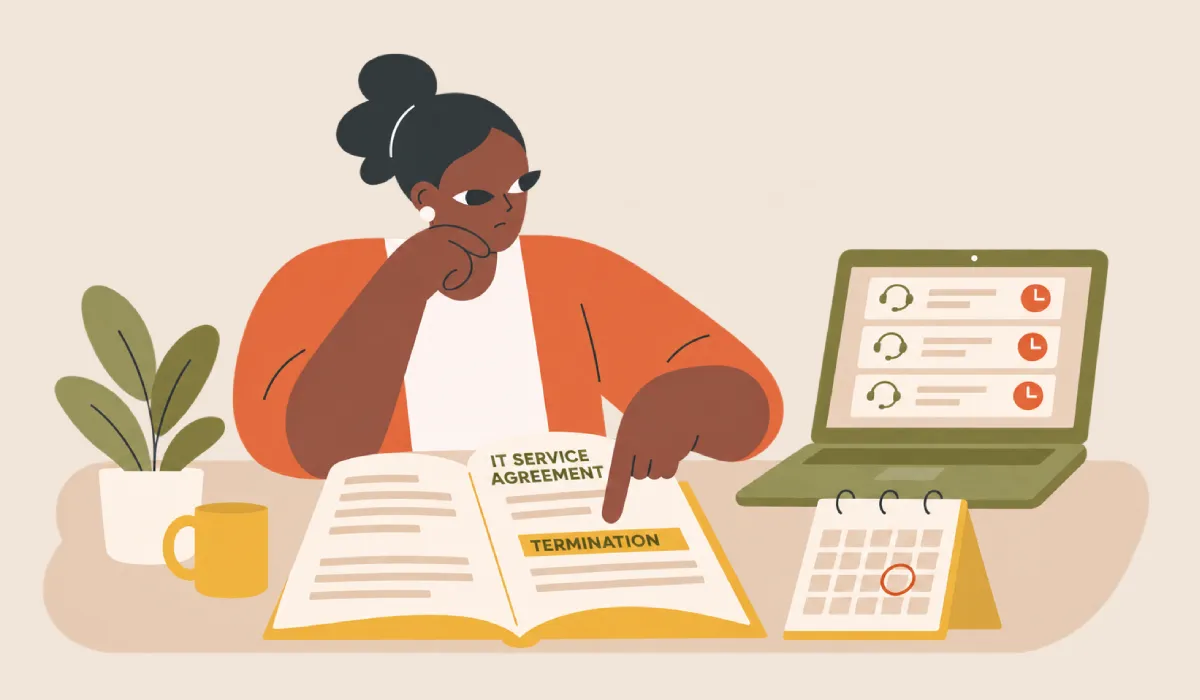
Termination of contract: poor service or a breach?
A supplier can be frustrating without breaking a contractual promise. The starting point is its contractual obligations: what it actually agreed to deliver.
In a service agreement, look in three places:
Scope or schedule: the work, deliverables, exclusions and deadlines.
Service levels: response times, availability targets and escalation steps, often in an attached service level agreement, or SLA.
Termination provisions: the failures that trigger an exit right and the procedure you must follow.
For example, a marketing agency might promise monthly reports without guaranteeing a particular number of sales. Disappointing sales alone would not establish that it broke the reporting promise. Missing the promised reports is a different issue.
Similarly, a four-hour response target does not necessarily promise a fix within four hours. Check when the clock starts, business-hour limits and exclusions before labelling a ticket a breach.
A breach and a right to terminate are separate questions. As business.gov.au explains, some breaches support damages without allowing termination.
Your contract may create specific termination rights, including for repeated failures. Otherwise, the seriousness of the breach and other legal grounds need assessment. A service credit may be the contractual remedy for an SLA failure, without settling every possible statutory right.
What your termination clause says
Read the termination clause alongside the SLA, payment terms, notice provisions and dispute process. Labels such as “material breach” need to be assessed against the actual wording and facts.
| What to find | What to check | Why it matters |
|---|---|---|
| Termination for breach | Defined breaches, repeated failures and any required seriousness | A missed target does not automatically trigger termination |
| Cure period | Time allowed to remedy the notified breach | The period may start on receipt, rather than when you send notice |
| Notice requirements | Delivery method, recipient, address and deemed receipt rules | An account-manager email may not satisfy the clause |
| Termination for convenience | Whether you can leave without proving breach, and on what notice | This route may involve an early termination fee |
| Exit charges | Remaining fees, discounts, equipment, licences and handover charges | A breach exit does not automatically remove every payment obligation |
| Handover | Data exports, credentials, work in progress and transition assistance | Ending the agreement must work operationally as well as legally |
Do not assume the contract offers termination for convenience. If neither party has an available exit right, a negotiated release may be worth exploring.
Check the renewal deadline too. Missing a notice window can change the proposed exit date and the remaining commitment. Keep renewal notice separate from any breach notice unless the contract supports combining them.
Worked example: the IT supplier you want to leave
Consider an illustrative Brisbane accounting firm with 12 staff and a 36-month managed IT service agreement. The monthly charge is $2,200 plus GST, or $2,420 including GST.
Seven of its last 11 urgent tickets took more than a day to receive a response. The SLA promises four hours. Assume the tickets fall within that promise, with no relevant exclusions.
The contract allows termination for a material breach that remains unremedied after 30 days' written notice. It also permits a convenience exit for 50% of remaining monthly charges.
For this comparison, assume 22 months remain at the effective exit date, after the required notice period. Assume the fee formula uses GST-inclusive monthly charges and expressly excludes the fee for a valid supplier-breach termination.
| Option at that date | Calculation | Amount compared |
|---|---|---|
| Convenience exit | 22 × $2,420 × 50% | $26,620 exit fee |
| Valid supplier-breach exit | Fee excluded under the assumed clause | $0 early termination fee |
| Continue for 22 months | 22 × $2,420 | $53,240 for continuing services |
These are different commercial options, not three equivalent exit costs. Outstanding invoices, transition work, equipment and replacement services are excluded. The assumed fee calculation is not guidance on the GST treatment of termination payments.
The firm cannot secure the second outcome merely by calling the failures “material”. It needs evidence, compliant notice and a valid right to terminate when it acts.
Its notice identifies the tickets, the breached promise and the required remedy. The firm records performance during the cure period and obtains advice before issuing any final termination notice.
If the supplier remedies the breach, that contractual exit right may fall away. Continuing failures still require assessment against the clause. The example therefore ends with a decision point, rather than a guaranteed fee waiver.
The fixed service charges total 36 × $2,420 = $87,120. That provides a useful starting point for checking statutory consumer rights.
Your rights under the Australian Consumer Law
A business buyer can qualify as a consumer. For services, one route is a price paid or payable of $100,000 or less, including GST. Services ordinarily acquired for personal, domestic or household use can qualify independently of price.
The inclusive threshold comes from section 3 of the Australian Consumer Law and regulation 77A. The ACCC explains how consumer protections can apply between businesses.
For a fixed service acquired under one agreement, consider its price paid or payable, rather than assuming each monthly invoice stands alone. The example assumes one fixed service costing $87,120, without additional charges. Variable fees, renewals and bundled supplies need closer assessment.
The consumer guarantees for services cover:
Due care and skill: services must meet the standard expected of a competent provider.
Fitness for a disclosed purpose or result: this depends on what was communicated and reasonable reliance on the supplier.
Reasonable time: this applies where the supply time is not fixed or determined by an agreed method.
There are specific exclusions and qualifications. Insurance and business goods-transport or storage services fall outside these service guarantees. Architects and engineers have a specific fitness-guarantee exception.
Do not assume the goods exclusion for purchases intended for resale also excludes every service bought for resupply. Identify the actual supply and applicable rule.
What remedy can you seek?
The ACCC's remedies guidance distinguishes minor and major failures.
| Problem | What it means | Available response |
|---|---|---|
| Remediable, non-major failure | The problem can be fixed and does not meet the major-failure test | Require a remedy within a reasonable time. If the supplier refuses or fails, seek reasonable external rectification costs or terminate |
| Major or irremediable failure | Examples include unsafe services or failures that would deter a reasonable buyer. Purpose-related failures have further conditions | Terminate, or retain the services and seek compensation for reduced value |
Several failures can collectively meet the major-failure test. Seven missed tickets alone do not establish that outcome; their nature, consequences and the legal requirements matter.
After statutory termination, a refund generally concerns services not already consumed. Properly completed work is not automatically refundable. Reasonably foreseeable loss may also support compensation, depending on the circumstances.
The Australian Consumer Law, sections 64 and 64A, also matters when reading remedy limits. The guarantees cannot simply be excluded. Certain business-service contracts can limit liability to resupply or its cost, subject to statutory conditions, including fairness and reasonableness.
Get advice on any service-credit or liability-limit clause before assuming it defeats, or cannot affect, your remedy. A contractual cure period does not automatically replace the statutory test for a reasonable remedy period.
When the exit fee itself may be unfair
A standard form supplier contract may attract unfair contract terms protections. Under the expanded regime, at least one party must have fewer than 100 employees or annual turnover below $10 million.
The changes generally apply to contracts made or renewed from 9 November 2023. Terms added or varied from that date have specific transitional treatment. Older agreements need a separate eligibility check.
An expensive fee is not automatically unfair. The ACCC sets out three requirements: significant imbalance, lack of reasonable necessity to protect legitimate interests, and potential detriment.
The contract as a whole and the term's transparency also matter. Only a court can finally determine unfairness.
A supplier agreement allowing the supplier an easy exit while imposing a heavy charge on you deserves scrutiny. Ask what the fee protects, how it is calculated and whether other terms offset the imbalance.
One-sided termination rights, penalties and limits on responsibilities are statutory examples of potentially unfair terms. An unfair term can be void while the workable remainder continues. Proposing or relying on such terms can also attract penalties under the applicable regime.
Our Insight on unfair contract terms and penalties explores that issue further. Do not treat your own unfairness assessment as permission to walk away.
How to end it without ending up in breach yourself
Before relying on a contractual breach right, work through these six steps. They are practical preparation, not substitutes for the agreement's requirements.
Build the record. Save ticket logs, emails, reports and invoices. Record the promised standard, actual performance and business impact for each failure.
Match evidence to promises. Identify the clause, applicable SLA and exclusions. Separate missed obligations from dissatisfaction with results the supplier never guaranteed.
Seek a written remedy plan. Explain the problem and ask for specific actions and dates. Keep this correspondence distinct from formal notice where necessary.
Serve the required notice. Check the recipient, delivery method, contents and deemed receipt date. Keep evidence of delivery and calculate the deadline carefully.
Assess the position when time expires. Record any remedy and remaining failures. Obtain advice before termination, withholding payments or committing to incompatible replacement arrangements.
Plan and document the handover. Agree timing, responsibilities, format and costs for data exports, credentials, licences and unfinished work. Check ownership and continuing confidentiality obligations.
Back up information your business is entitled to access before the relationship deteriorates. Ask a replacement supplier what it needs for a safe transition. Avoid creating another outage while trying to leave the first provider.
If you negotiate a release, record the effective date, final payments, handover duties and any agreed settlement of claims. A verbal assurance that “we will sort it out” leaves too much unresolved.
If the supplier disputes it
Read the dispute clause early. It may require escalation or mediation, but check how it interacts with termination and urgent relief.
The Australian Small Business and Family Enterprise Ombudsman's Dispute Support tool helps identify an appropriate resolution service. State-based small business commissioners may also assist, depending on their remit and the dispute.
Keep settlement proposals, factual records and legal advice organised. If systems or data access are threatened, seek urgent advice rather than waiting for routine escalation.
When to call a lawyer
Before a termination notice based on a disputed material or serious breach.
When the fee, remaining commitment or disruption would materially affect the business.
When consumer status, the acquired service or a limitation clause is uncertain.
When you want to allege unfair terms or claim compensation.
When the supplier disputes your rights, threatens proceedings or controls essential data.
Bring the signed agreement, schedules, variations, notices, invoices and failure log. Ask which exit route is available, what it costs and what obligations survive.
Before the next engagement, read what to check before signing a supplier's terms. Clear performance standards and workable exit arrangements make later decisions easier.
What this doesn't cover
This article focuses on business purchases of supplier services. Leases, employment, independent contractor and construction agreements can raise different issues. It does not explain frustration, detailed damages calculations or every possible termination ground.
Upcoming unfair trading rules are also separate from the current rights explained here. The 2026 amending Act commences on 1 July 2027. Its general prohibition excludes supplies in the course of the consumer carrying on a business.
Verified 16 November 2026 against the Federal Register of Legislation, business.gov.au, ACCC and ASBFEO sources linked above.
Your supplier contract shapes the exit long before you need it. Upload your agreement to identify terms that need attention, including notice periods and exit costs.
Contractam provides contract review and information, not legal advice. For advice specific to your situation, consult a qualified Australian lawyer. Contractam reviews contracts under Australian law only. See our disclaimer.